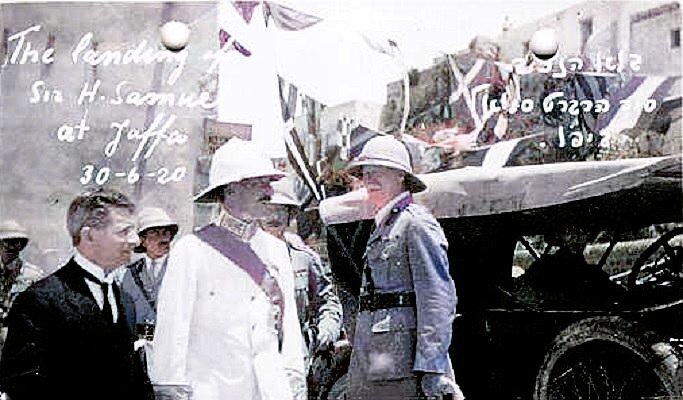
The photograph of Sir Herbert Samuel landing at Jaffa on June 30, 1920, comes from this World Zionist Organization webpage entitled, "The High Commissioner Arrival to Palestine," and was colorized with Lunapic.
January 15, 1919. El Eco Franciscano, revista quincenal ilustrada, year XXXVI, number 608, pages 35-37.
Monsignor Charmentant, distinguished Prelate and director of the schools of the East, proposes for possible consideration by the Peace Conference the convenience of ceding Palestine (or at least the Holy Places) to the Holy See under the title of "temporal dominion."
As regards Palestine—soil desired by all the nations, soil consecrated by the Redeemer of mankind, soil doused with the blood of Christians from every kingdom; holy places sustained with the alms of Catholics from all over the world, guarded and defended heroically for over seven centuries by the Franciscan Order, the most international Order with presence all over the round Earth, to which Benedict XV, in reward for its secular sacrifices, has confirmed and given the holy places to for custody in the foreseeable future—we fully and ardently wish that the Holy Land be governed, with respect for acquired rights, by an international Committee of Christian powers, one of whose members at least must represent the Roman Pontiff.
Catholics everywhere, we are going through grave moments when trammels will either be taken off or put on for centuries to come! Let us ask heaven for light and protection to fulfill the wishes of our most loving Father Benedict XV.
FR. MANUEL PÉREZ
February 6, 1919. El Regional, year XXXVI, number 12193, page 2.
Palestine, i.e., the Holy Land, whose capital is Jerusalem, will be freed from the Turkish yoke by the patronage of the League of Nations which will designate a great power as its accountable agent. This was in principle the decision adopted on January 30 at a meeting of the delegates to the Peace Conference. After a detailed assiduous study of the matter France approved the resolution decidedly. The delegates of Arabia did not object.
According to reliable reports Great Britain will be the power which will assume the responsibility for guaranteeing the liberty of Palestine in consonance with the Zionist program. Consequently the Hebrew dream (to have an independent territory) has materialized. Zionism is a fait accompli.
The proposals that envisioned Palestine as a province of Arabia or as a dependency of Great Britain were apparently rejected.
The rumours that a North American protectorate would be established in Palestine also proved groundless.
November 20, 1919. El Correo Gallego, year XLII, number 15091, page 3.
It has been decreed that Hebrew will henceforth be the official language of Palestine.
April 28, 1920. Galicia Nueva, primer diario de Villagarcía, year XIV, number 2833, page 4.
London, 27. A dispatch from Cairo cites skirmishes between British troops and Arabs in Palestine. Details are wanting, but it's believed that calm has been restored.
June 24, 1920. El Ideal Gallego, diario católico, regionalista e independiente, year IV, number 1020, page 1.
Rome, 23. Sir Herbert Samuel the new High Commissioner for Palestine has already departed London en route to Jerusalem. He will make a stopover in Rome to hold an audience with the Pope.
February 14, 1921. La Integridad, diario católico, year XXXIV, number 9249, page 1.
By telegraph. The king of Hejaz contested in London the legality of Great Britain's mandate in Palestine, considering it incompatible with the promises made by Great Britain some time ago.
The Arabs request that a sovereign independent State be constituted, sustained by a bureaucracy and English capital.
May 1, 1921. El Eco Franciscano, revista quincenal ilustrada, year XXXVIII, number 661, pages 200-202.
In the first place let it be known that he who writes these lines was present before during and after the war; he has witnessed all the political transitions of Jerusalem, all the flip-flops in the hostilities, the victory and the armistice; he shuddered with all Christians at the Muslims' fanatical reaction; he laboured to shield churchly belongings from the greed of the Turkish Government or troops; with growing anxiety he watched from the height of the Judean mountains the advance of the Anglo-Egyptian army and the combats it sustained on the Sharon; he awaited impatiently the arrival of the day when the Holy Places passed from the usurping hands of the disgusting Muslim to the Christians who for so many centuries were unjustly dispossessed of them; and at times of anguish (for we were in the crossfire) he observed from the terraces of the Basilica of Bethlehem the movements of the two battling armies and the din produced by the countless machine guns and mighty artillery of the British whose shells swept the last Turkish forces away, not to mention watching the dogfights which horrified us and drove us to retreat and run almost out of breath to prostrate ourselves before the Divine Infant in the Holy Grotto, beseeching him with tears in our eyes to grant the world that peace which he announced to mankind on the day of his birth here; I prayed for the poor Christians menaced by the riled Turk with internment; we prayed also for the security of our Sanctuaries; I witnessed the decisive battle of December 7-8, 1917, vigil of the Immaculate and an unforgettable day for the Bethlehemites who told me, "the Virgin protected and liberated us on her Feast day"; and indeed, before noon on December 8, the English vanguard reached Jerusalem; finally we witnessed on December 12 the triumphal entrance of the English generalissimo Edmund Allenby to the Holy City. We saw with satisfaction that French and Italian units accompanied the English troops, and the remembrance of the Crusaders crossed my mind, given that some similitude did exist, given the enthusiasm of the multitude cheering the liberators of Jerusalem ceaselessly.
Withal many Protestant and especially Zionist or Jewish missions entered Jerusalem with the triumphant Allenby. Every one of them enjoyed freedom of access in Palestine beneath the military uniform whereas Catholic missions found shut doors no matter what stripe they wore. The Zionist missions were American, English, French and Italian. And it even appears that the Franco-Italian military auxiliaries in Palestine or at least the Italian ones (so writes the Italian newspaper, L'Avvenire d'Italia) did not come to Palestine but to camouflage the Zionist mission under their name and military insignia. The behaviour of the Colonel-Commandant of the Italian contingent is proof of this deft disguise; he was a most intelligent Hebrew of great ascendancy with the consular authority of that Nation, and he later attended the Conference of San Remo.
While France and Italy disengaged from a political discussion of Palestine and in 1919 repatriated the sentries guarding the Holy Sepulchre and the Holy Grotto of Bethlehem, the Conference of San Remo approved the creation of an autonomous Jewish-Zionist state in Palestine, or as they said in Jerusalem, "rolled a lump of unleavened bread baked under ash for the Jewish Passover."
No one raised their voice to protest this theft and trampling of the rights of non-Hebrew Palestinians. Not even the organs of law-abiding political parties raised the alarm against this enormous injustice sanctioned by the Conference of San Remo. It was a conspiracy of silence, the complicity of Christian nations—or better said—of their representatives who endorsed so bizarre a motion opposed to the rights of Catholics. Even the Catholic press failed in general to grasp the reach of the statute ratified at San Remo, which condemns non-Jewish Palestinians to ostracism (I refer to indigenous Christians and Muslims) for they will be treated as foreigners according to the good law.
Is is not that by writing these lines I intend to anathematize the ability or shrewdness of Zionist-Hebrews working for their cause. Or Protestant England's assistance to Zionism to the extent of imposing a Zionist Government on Jerusalem; this can be partway understood though it be an injustice promised to the Jews during the great war in return for the assistance rendered to England by Jewish banking and the major press.
However it is inconceivable that representatives of Catholic Nations should approve a new Zionist statute. It is this I protest against. It is an injustice and even a betrayal of Christianity for a bad tree can not yield good fruit. Moreover Western Nations did not ally with or fight beside England, or their soldiers sacrifice their lives, in order that vanquished Jerusalem should ultimately be delivered to the degenerate Jewish lineage. Nor did Jerusalem's bells ring out merrily, nor was the Te Deum sung in all the Churches of the Christian-Catholic world, for that prospect on the day of Jerusalem's conquest.
Faced with so great an injustice everyone kept mum.
O servile criminal silence!...
SPICULATOR
May 14, 1921. El Ideal Gallego, diario católico, regionalista e independiente, year V, number 1260, page 3.
London, 13. The situation in Palestine is ominous. Jews and Muslims brawl continually.
June 16, 1921. La Integridad, diario católico, year XXXIV, number 9354, page 3.
By telegraph. Jaffa awaits the arrival of a vessel bringing five hundred Jews to this city. The alarmed citizenry plans to obviate the disembarkation. The workers resolved to deny the Jews transportation. As a result disorders broke out in which two Jews were slain and eight injured.
June 17, 1921. La Voz de la Verdad, diario católico antiliberal con censura eclesiástica, year XI, number 3641, page 1.
The Pope presided over a secret Consistory attended by all the Cardinals resident in Rome and by the Cardinal of Warsaw.1
His Holiness delivered a short address lamenting the privileged and preponderant status of the Jews in Palestine—a situation he deems dangerous for the Christian residents—and bemoaning the plans of the Jews to convert a region that wards the most august mementos of the Christian Religion into a venue for pleasure.
"We the Christians," said the Pope in closing, "must grapple with the Society of Nations and urge a review of England's mandate in Palestine."
June 20, 1921. La Integridad, diario católico, year XXXIV, number 9357, page 1.
Winston Churchill the English Minister of the Colonies has tabled in the House of Commons a proposed budget worth more than 27 million Sterling Pounds. Those millions will cover the expenses of the so-called Middle East, i.e., Mesopotamia and Palestine.
Churchill wishes both countries to be autonomous and self-governing.
He proposes the crowning of an Arab sovereign in Mesopotamia elected by the natives on the sole condition that the sovereign be persona grata to Great Britain.
In other words, he wishes the ancient country where Chaldeans and Assyrians forged a great empire to be granted a sovereign without sovereignty, something like a cork oak without cork or like an English walnut tree without walnuts. England will provide the cork and the walnuts in exchange for the miserly production of the valleys of the Tigris, Euphrates and Shatt Al-Arab.
Simultaneously it is necessary, according to Churchill, to prepare a Palestinian home for the Jewish race. There a people was formed whom Titus dissolved and whom Great Britain wishes to resurrect.
Churchill says that Great Britain must curb the egress of Israelites from Palestine because Albion promised to create a nation for them there [the Balfour Declaration of 1917].
Churchill discounts the curse that weighs down the deicides. A new Julian tries to settle Judaism where Our Lord Jesus Christ was crucified by the accursed race, where Godfrey refused to be crowned a monarch because they had set a crown of thorns on the Son of God there.
Will England succeed? No, she will not. The mere attempt has already cost a lot of blood. Christians and Muslims are upset and contend the English wish. The Jews are not wanted there.
The mere news that an expedition of Jews is set to arrive in Jaffa has riled its inhabitants and stirred them to block the disembarkation by all means at their disposal, disregarding the orders coming from Great Britain promising to interfere not in the country's internal affairs.
The Jews will never jell into a people because it has been so decreed already. Twenty centuries have elapsed and, in spite of all the efforts exerted to the contrary, the Jews are still scattered all over the world.
Withal England carries the spirit of destruction within her. She wants to assert her dominion around the world and presently she foments anarchy to establish herself in those aforetime peaceful regions of Asia. The arrival of the Jews will spark riots and wars. The thing is to rattle the peoples; and Albion brings that off indeed...
Clarabana 1
June 25, 1921. El Compostelano, diario independiente, year II, number 412, page 1.
The politicians of Great Britain labour to establish the home of the deicide race in Palestine. The ambitions of the Jews enjoy the support of the "makers" of nations. The Jewish people, encouraged by England, wish to put their footprint and to create a nationality in the holy places where the mysteries of mankind's Redemption transpired.
[...]
The Pope [Benedict XV] expressed at the latest Consistory his fears that the Jews will possess the Holy Places. The Pope said,
You will certainly remember that at the secret Consistory of March 10, 1919, we displayed our considerable worry at the turn of events in Palestine after the war; a land consecrated by the Divine Redeemer in his mortal life and beloved of Us and of every Christian heart. And that apprehension of ours, far from diminishing, is increasing by the day.
The soil where Christianity and Charity bloomed—visited by Godfrey of Bouillon, Tancred the Brave, Raymond of Saint-Gilles, Hugh the Great, Richard the Lionheart, the Baldwin dynasty and the Knights Templar—is purposed to be presented to the descendants of the assassins of the Son of God.
His Holiness reveals in his speech that he experienced great joy when Allied troops recovered the places trodden by the Saviour, but he appends,
That joy of ours was not exempt from the concern expressed in the cited Consistorial address that after such a magnificent and happy event the Israelites could find themselves in a situation of preponderance or privilege in Palestine.
Judging by the current state of affairs what we feared has been amply realized. It is public knowledge that the status of Christians in Palestine not only has not improved but worsened considerably under the new regulations promulgated there which tend—if not intentionally, certainly objectively—to eject Christianity from the positions it had to date in order to lodge the Hebrews in them.
And the Pope's voice presently rises to demand justice and to exhort everyone to peace with these words,
Since the status of Palestine is not definitively settled, We raise our voice forthwith so that when the time arrives to give stable governance to Palestine the inalienable rights of the Catholic Church and of all Christians shall be guaranteed.
We certainly do not wish to infringe the rights of the Hebrew constituency but we understand that theirs must not transgress the rights of Christians in any way.
And to this end we fervently exhort the Governments of all Christian nations, non-Catholic included, to watch over and contend before the Society of Nations which, it is said, must peruse the conditions binding the English mandate in Palestine.
Christendom must not brook that Hebrews become the masters of those regions replete of holy reminders.
The sea of Tyre on which the ships of the prophet King sailed to inspect the lofty cedars of Lebanon's mountains and the Sidonian purple or that sea which borders Galilee's meadows and the plain of Ashkelon must not be—shall not be—though Albion the current lady of the seas tries her hardest—fiefdom of the race cursed for the greatest crime in History...
Clarabana
September 9, 1921. La Integridad, diario católico, year XXXIV, number 9425, page 1.
Great importance is attributed to the private audience that His Holiness granted General Storrs the military governor of Jerusalem who stopped over in Rome on his way to London a short while ago; he is now in London conferring with the central authorities.
The imprudent behaviour of the Zionist organizations and their violent interpretation of the Balfour Declaration on the "national Home for the Jews in Palestine" has altered the public mood markedly. This together with the voluntary distancing of several prominent American Zionists will probably bring about the revision of the original tenets for the Mandate of Palestine.
Although the High Commissioner in Palestine is Jewish, the military governor of Jerusalem is Anglican, the son of a distinguished dignitary of the Anglican Church. His personal view sides with those who worry over the safeguard of Christian interests in Palestine, in light of which the private audience of the governor with the Pope assumes exceptional importance.
July 5, 1922. El Compostelano, diario independiente, year III, number 719, page 1.
Here is the literal text of the communication which Cardinal Gasparri the secretary of the Holy See has sent to the Society of Nations regarding the project of the British mandate over Palestine.
The Holy See does not oppose that Jews enjoy civil rights in Palestine akin to those enjoyed by other nationalities and religious confessions; but it can not give its consent to:
(1). That Jews should obtain a privileged and preponderant position in respect of the rest of nationalities and religious confessions.
(2). That the rights of Christian denominations be hardly guaranteed.
In regard to (1) the project [i.e., the British Mandate] pretends to establish an absolute economic, administrative and political preponderance of the Jewish element in detriment of the rest of nationalities. Such a project is in disagreement with Article 22 of the Treaty of Versailles which sets down the nature and goal of any mandate.
In regard to (2) Article 14 of the project must be gone over; it establishes that a special Commission shall examine and regulate all the affairs and claims pertaining to the various religious confessions. The Commission, made up of an unspecified number of members, must include representatives of all the religions whose interests hang in the balance. Evidently the Holy See can not consent that Catholic affairs be administered by representatives not picked by its hierarchical authorities. The Commission must also ensure that the holy places and the religious buildings especially venerated by the followers of a particular religion shall be inspected continually by the appropriate corporations authorized by the adherents of that particular religion. The terms of Article 14 are so vague that it breeds numerous difficulties when certain sanctuaries involve more than one religious confession.
It is therefore necessary to forestall the strife that will plague this Commission and expose Article 14 as unworkable. The Holy See volunteers the suggestion that the Commission members be the Consuls assigned to Jerusalem by the powers with representation on the Council of the League of Nations.
July 28, 1922. El Ideal Gallego, diario católico, regionalista e independiente, year VI, number 1586, page 2.
An Arab Delegation of Palestine has sent a note to the League of Nations protesting the ratification of the British mandate over Palestine. They also contend the establishment of a national Jewish State.
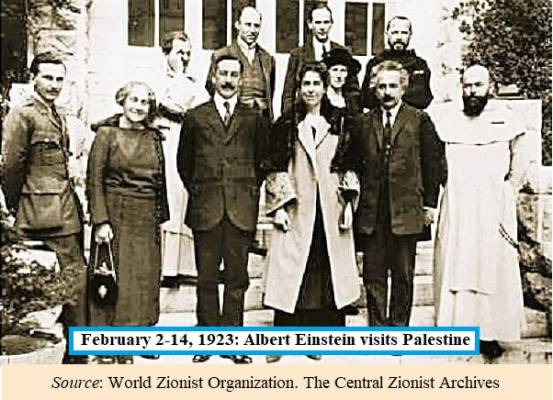
March 15, 1923. El Eco Franciscano, revista quincenal ilustrada, year XL, number 706, page 139.
At long last the census of Palestine was published after a delay of several months. The census did not bring great satisfaction to the Jews, they expected better numbers.
Palestine has 757,182 inhabitants, distributed by faith affiliation as follows: 590,890 Muslims; 83,794 Jews and 73,024 Christians. The remainder groups various other faiths.
The official figures were published in the newspaper Palestine Weekly which bemoans the fact that although there were a hundred thousand Jews before the war and that at least twenty-five thousand arrived since the end of the war the Jews presently number only 83,794.
The paper comforts itself with the Christian statistic because subtracting three thousand Armenian orphans and five thousand Westerners who will soon leave the country the number of Christians in Palestine will drop from 73,024 to 65,000 approximately.
The same could be said by us about the Jews. Although it is true that many arrive from Europe and North America it is also true that many leave, disillusioned with not finding the plenty and wealth they had hoped to discover in their fancied land of biblical promise. They are also disappointed with the mistrust evinced by the indigenous Jews whose forefathers dwelled here since Antiquity. The indigenous Jews protested publicly the behaviour of the newcomers, saying that the Zionists only ruin the peace which indigenous Jews had enjoyed with the Arab population.1 In this regard the Great Rabbi deemed it his duty to publish an open letter to Israelite workers and employers decrying the bad impression they give everyone with their mockery of religious practices.
Contravening the widest possible freedom of religion guaranteed by Article 15 of the Mandate for Palestine—approved in July 1922 in London—the Grand Rabbi was notified that no European Jew may change his religion without permission from the corresponding government, that no Jew will be allowed to switch religion until they are twenty years old and that those who wish to do so must first appear before the Grand Rabbi, who must legalize their conversion to another religion if he fails to dissuade them.
This procedure obstructs significantly the switch to the Catholic religion by the few Jews who, convinced of Judaism's falsehood, desired to embrace Catholicism. The odd such case had been occurring.
Thus are regulations arbitrarily understood and interpreted!
ARACIL Y PONS.
Jerusalem. February 1923.
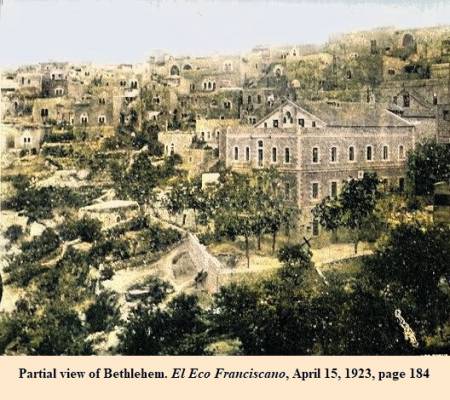
April 27, 1923. El Compostelano, diario independiente, year IV, number 958, pages 1-2.
In order to tender some justification for her policy and desiring to mete a light sedative to bristly tempers England declared that since Arabs are incapable of governing themselves, less can they administer the upper posts of the State... those jobs with the highest pay.
Facts indicate that the opposite is true. In the previous administration of Palestine, before the British occupation, there was less bureaucracy, fewer parasites, not a single Hebrew, and yet matters worked as well. A substantive example. Four or five employees managed everything at the Treasury, Jerusalem's chief livelihood. Presently eighty-nine are not enough. Of these more than a third are Hebrews who altogether make annually the nice sum of 23,895 Egyptian liras ≡ 621,270 gold Francs. Thus prospers poor Palestine under the Hebrews' umbrella!
All Arab urbanites educated at the flourishing European boarding schools (plentiful in Palestine) can speak three or four languages fluently.
Zionist organs expose the source of the trouble in Palestine unambiguously. In one of the tragic instances when Hebrew discontent vented most vividly, shortly after the disorders of Jaffa, for they judged British protection paltry, The Jewish Chronicle of July 22, 1921, stated on page 22,
It is very difficult to discover the source of this problem and apply a remedy to it. It is not enough to say that the Arab population is up in arms because of the Balfour Declaration...; it is necessary to examine the root and origin of everything.
Let us examine the principal causes: except for British holders of top Government jobs the rest of civil servants knows nothing and lacks initiative. They do not understand the temperament of Arabs or Hebrews. Most are Army veterans, officers and lower ranks... It is necessary to grasp that not one had the least acquaintance with or training to handle civilian affairs.
No comments are necessary.
Since we have remembered the bitter moments currently experienced by Palestine we shall also remember how peacetime unfolds in the Anglo-Zionist kingdom.
Say the tattletales...that when the Hebrew Committee informed Sir H. Samuel about the turmoil in Jaffa he replied, "If Hebrew leaders express their mistrust publicly I am prepared to quit my post; but it may be that a substitute High Commissioner will be sent who is a friend of the Arabs!" Wherefore peace once more shone in the clear sky of Palestine between the British crafters of the Kingdom of Zion and the raw material of this same Kingdom, the Hebrew immigrants.
Thus calm abode patiently, stubbornly, until the Zionist intrusion reached all branches of the public administration in our days.
Today all the gros bonnets of the administration are Zionists: Sir Samuel the High Commissioner; Mr. Bentroich the Legal Secretary, Minister of Grace and Justice; Mr. Solomon the Director of Customs; Mr. Beeds the Civil Secretary, Minister of the Interior; Mr. Montefiori the Chief of Police, have at their beck and call a bureaucracy in more than 50% composed of fanatical Zionists and whose top and best-paid government jobs are in the hands of Zionists.
Understandably Zionism has under such conditions found it easy to accomplish veritable miracles in the course of a few months.
Fra Luis Aldrey Pereira.
Bethlehem. April 10, 1923.
July 1, 1923. El Eco Franciscano, revista quincenal ilustrada, year XL, number 713, page 294.
Sir Ellis Kadoorie the well-known philanthropist has bequeathed a hundred thousand Pounds Sterling to the British government destined for the schools of Palestine and Mesopotamia. By a decision of the same government and of the executors of his will the entire amount will go toward the construction of Hebrew schools in Palestine.
Catholic missionaries need similar legacies so that considerably more work might be done for the good cause.
* * *
We know from local newspapers that the area of Palestinian land purchased by the Jews is 775,000 donums to date (1 donum = 900 square meters).1 The parcels of land are distributed as follows. 180,000 donums in Judea (i.e., Jerusalem and environs); 170,000 donums in Samaria; 235,000 donums in Lower Galilee; 100,000 donums in Upper Galilee and 90,000 donums east of the Jordan River.
Fr. ANTONIO ARACIL.
Jerusalem, May 1923.
November 17, 1923. El Ideal Gallego, diario católico, regionalista e independiente, year VII, number 1923, page 6.
Spurred by material and political interests, though racial and religious angles were adduced for the attempt, the Jews wanted to restore the kingdom of Israel; but the weight of facts, more powerful than the handiwork of men, is felling the work done and even its initial aims.
As in the memorable construction of the Tower of Babel when God's finger bred confusion in the languages to punish human folly at the precise moment that Pride thought herself victorious, so it is with the Zionist adventure: when Jewish banks had bestowed their gold, nations their acquiescence, when England had espoused the project and thousands of Israelites from all corners of the globe had settled in their ancient homeland—presently a "national home"—lo! the Zionist leadership recently gathered at the Carlsbad Congress resolves that the "current circumstances do not permit the creation of a Jewish fatherland in Palestine."
Must the solemn fiasco be pinned on the immigration of "undesirables, ill-suited, rapacious and troublemakers" for whom a British correspondent urges immediate repatriation? Must the determinant factors be imputed to the unyielding soil and the expensive tillage, to the aggravation that besets Jews on switching from their traditional career in commerce to a new one in agriculture, be imputed to the immigrants' steep mortality rate (a point highlighted by some writers also) or rather might all these factors be merely the means by which God's providence has watched over the Holy Land?
* * *
The hard and bitter word of failure and defeat is not a cutting from our harvest. Writes Doar Hayom, a Judeo-Palestinian newspaper,
We are witnessing here in Jerusalem wholesale emigration like never before was seen since colonization began. Hebrews leave the country en masse. It is heartrending to see the faces of those poor men and hear their bitter tales. Any effort to stem the migratory flow would prove futile because it would always meet the same response: our patience is limited, we have no faith in the future.
Meantime no prospects of an improvement are forthcoming. The emigrants know that America has shut its doors, that London has thousands of unemployed, that there is revolution in Mexico, that yellow fever ravages Brazil, that persecution of the Jews is on the order of the day in Argentina—notwithstanding all this, the emigration runs on.
What does it matter if thirty thousand arrive when twenty thousand depart, and when the newcomers are unfamiliar with the tough living conditions of the country?
J. POLO BENITO.
December 1, 1923. El Eco Franciscano, revista quincenal ilustrada, year XL, number 723, page 536.
On October 1 the so-called Patriarchal University of Jerusalem opened its doors in the premises of the old Latin Patriarchal Seminary to two hundred and fifty young men from all over Palestine, Catholics and Muslims. Its main goal is to build an Arab College where Arab language and literature are taught alongside Medicine, Law, Architecture, Social Works, Commerce, etc.
* * *
The Muslims also try to found a Muslim university in Palestine to be an intellectual and religious center for the formation of ulemas [doctor in Islamic law] and ministers of the Islamic cult, muftis [Islamic interpreter of civil law invested with public authority, whose decisions are law], qadis [a civil court magistrate among Turks and Moors], lawyers, orators and teachers, according to the manifesto published by the high Muslim Legislative Council of Palestine. They have already established a new Arab library housing about three thousand volumes in the dependencies of the Mosque of Omar.
* * *
The Jews are having not a few headaches establishing their national home in Palestine. Systematic Arab opposition on the one hand and insufficiency on the other compel many Jews every week to buy the return ticket to the distant countries of Europe and America.
May they have a good voyage and never return.
* * *
Emir Abdullah the sovereign of Transjordan (ordained King of that country last May) has come to Jerusalem.
He has already been challenged by an influential Bedouin chieftain who spearheaded a strong band of rebels, besieged Amman (the new kingdom's capital) with the intention of overthrowing the Emir.
For once the attempted coup failed and the rebel chieftain got the worst of it with many dead and wounded.
Fr. ANTONIO ARACIL, O.F.M.1
Jerusalem, October 1923.