October 14, 1914. El Eco de Galicia, diario católico, year XI, number 2579, page 4.
They say from Rome that Turkey is demonstrably making preparations for war. There is great military activity in Syria, Arabia and northern Palestine. Important points on the coast and on trails heading to the interior of Syria and Palestine are being fortified. Everything suggests that Turkey's intervention in the war is imminent.
October 31, 1914. El Diario de Pontevedra, year XXXI, number 9152, page 3.
At 3:30 AM hostilities erupted between Turkey and Russia when two Turkish torpedo boats entered the port of Odessa and sank a moored gunboat.
At 9:30 AM a Turkish cruiser bombarded the station and city of Feodosia (Crimea). The shells damaged the Cathedral, the Greek church, the pier and port and set a branch of the Russian National Bank on fire.
November 6, 1914. Progreso, diario independiente, year VIII, number 1477, page 3.
Madrid, 1:00-4:00 AM, urgent. London: A special edition of The Gazette publishes Britain's official declaration of war with Turkey. The British have annexed the Isle of Cyprus.
November 9, 1914. Gaceta de Galicia: Diario de Santiago, year 42, number 228, page 3.
A British cruiser has shelled the Turkish port of Gaza in Palestine.
November 10, 1914. El Eco de Galicia, diario católico, year XI, number 2606, page 4.
The British fleet has bombarded Jaffa, destroying the radio-telegraph station linking the port with the entire coastline of Asia Minor. The Turks flee inland. The French and British consuls in Jerusalem and other Palestinian cities have boarded a vessel for personal safety.
December 1, 1914. La Voz de la Verdad, diario católico antiliberal con censura eclesiástica, year V, number 1323, page 2.
The authorities of Jaffa have stirred up the population against the Christians. Should the Allies make a landing, the Turks will burn the city down rather than surrender it. The situation in Jerusalem can not be more critical.
December 13, 1914. Galicia Nueva, primer diario de Villagarcía, year VIII, number 2833, page 1.
The Turkish Navy has limited its operations on the Black Sea and along the coasts of Asia Minor, Palestine and Egypt because of a current shortage and impending lack of coal.
Turkey had negotiated with Britain the purchase of 80,000 tonnes of coal before the onset of the European war and received 30,000 tonnes in short notice. When war broke out between Germany and Austria, on the one hand, and France, England and Russia, on the other, the unequivocal hostility of Turkey toward the Allies moved England to withhold shipment of the 50,000 tonnes outstanding. It is estimated that Turkey has 20,000 tonnes of British coal left and that this quantity will be consumed in the course of the month of December so that by next January the Turkish Navy will not have the coal it requires for operating.
Turkey has mines of its own in Kustamuni Province, bordering on the Black Sea not far from Constantinople, but their coal's gross calorific value is much lower than Cardiff's or Newcastle's and this will make Turkish warships run too slow. Germany can not help Turkey out, and so it is estimated that around the start of the year 1915 the Turkish fleet will be moored dockside.
November 22, 1915. La Voz de la Verdad, diario católico antiliberal con censura eclesiástica, year VI, number 1728, page 1.
Paris. The insurrection of the Arabs in Syria and Palestine gains ground. Several Turkish and German envoys sent from Constantinople were taken prisoner.
January 1, 1916. El Progreso, diario independiente, year X, number 1824, pages 1-2.
According to Le Temps the Turkish plans for Egypt have aroused a great stir in Jerusalem. Military authorities drafted all able-bodied men between the ages of 18 and 60. The rest work in defence-related projects. Railway lines are reserved for wartime transportation. All cattle fit for packing or hauling has been impounded.
The local authorities compelled Italian Jews to choose between expulsion or renouncing their Italian citizenship. Many opted to renounce. A minority will be deported to Italy aboard American cruisers.
Several Jewish newspapers written in Hebrew still circulate under the scrutiny of the authorities.
February 15, 1916. La Región, year VII, number 1826, page 2.
Nauen. The English suffered an important defeat in Egypt. The losses in men and matériel is enormous.
June 29, 1916. Galicia Nueva, primer diario de Villagarcía, year X, number 4179, page 2.
London, 28. News from Cairo state that Turkey is sending large reinforcements in haste to Arabia with the object of protecting the sacred places of Islam from insurrectionist mobs.
July 28, 1916. El Norte de Galicia, diario político y de información y el de mayor circulación en Lugo y su provincia, epoch II, year XIX, number 4425, pages 2-3.
The mind fixates on Belgium and on Poland when pondering a future far-off peace. Many people wonder: what will the eventual status of the two kingdoms be after the war?
Withal few times have we heard the same question put forth regarding the Jewish race that inhabits Russia. The Jews of Russia have a legal status incompatible with civilization. The Russian peasant or soldier views the Jew as an alien to Humanity. Muscovite troops behaved reasonably well during their occupation of Lemberg. Only in the Jewish quarter did they massacre, pillage and commit all kind of excesses and abuses. This hatred, which predates the war, spurred a large segment of the Israelite population to emigrate from Russia to the United States or to London.
In the spring of 1914 English newspapers examined the problem of Jewish immigration and its harmful impact on the interests of British workers. The war removed this topic from the concerns of public opinion for the abundance of work dispelled the fear of Jewish access to the competitive labour market, but the unease revives with the introduction of compulsory military service, as I've had occasion to verify.
Russian Jews living in London retain their original citizenship, which enables them to dodge military service. They were initially invited to enlist voluntarily in the British Army; the invitation did not yield a good return. And so it turns out that whereas native Englishmen are subject to military service—more or less effectively—the Israelites who fled Russia, sought asylum in England and used the advantages of British legislation during peacetime presently use their alien status to advantage and elude the obligation to fight.
Is it out of cowardice? No, certainly not.
Mr. Vladimir Jabotinsky (bold font mine.—EFC), a Zionist personality, submits the following explanation,
It's because the Israelites who are invited to enlist say, "An Englishman heading to war knows he is helping to ensure the freedom of the British race in the world. Can you assure us that if we go to war we will be promoting liberty for the Jewish race?"
Because if Russia were in effect to triumph, if Tsarist Russia, martial, fanatical, were victorious in this war, would our enlistment have advanced the freedom of the Jewish race in her vast territory?
I plead with the English public to apprehend the feelings that swaddle their objection to serve. The Jews must do military service but they must be treated like an ancient race that has suffered wrongs and has legitimate aspirations...
In short, the good Zionist proposes that special units designated with Hebrew names be assigned to fight in Egypt on the front line nearest Zion, naturally.
If British military operations should one day stretch from Egypt to Palestine—he says—the Jewish soldiers would be the ones called upon to give their lives for the redemption of the land that is Israel's hope. Therefore the enlistment must be administered rousing their enthusiasm, not threatening them with deportation.
It is clear from all this that the Jewish problem is much more complex, more wrenching than the Polish or Belgian question because the Israelites do not have a territory or even a territorial sentiment, setting aside the minority that pretends to restore the kingdom of Israel on biblical lands. The Jews must therefore fight as foreigners in all armies without collective glory or the hope of emancipation where they are still oppressed and mistreated, as they are in Russia. And this would be the opportunity for restoring the Jewish kingdom or at least for promising the fulfillment of the Zionist daydream now that the Allies mean to tear Turkey asunder. But not even this hope is given the poor Jews. And the very same Times which finds the Zionist writer's idea admirable (the creation of Israelite military units with Israelite names) hastens to add that any territorial pretensions of the Jews are not up for discussion presently...
JUAN PUJOL 1
May 7, 1917. Galicia Nueva, primer diario de Villagarcía, year XI, number 4261, page 2.
London, 6. News from Cairo state that Ottoman troops evacuated Jaffa and other localities on the Palestine front.
June 14, 1917. El Progreso, diario independiente, year XI, number 2259, page 1.
For some time now the Ministry of State has been receiving requests from various bodies in Europe and America for an intervention of the Spanish Government before Turkey to annul the measures it has taken against the Israelites of Palestine. In several occasions Mr. Yahuda and Mr. Max Nordau had talks on the issue with Mr. Alvarado the Spanish minister of State. Lately the Allies solicited the personal intervention of His Majesty Alfonso XIII to relieve the condition of the Israelites forced to evacuate their dwelling places in Palestine. Following the earnest diplomatic efforts of the Government of His Majesty the Turkish Government has informed the Spanish Government that the military authorities of Palestine have been ordered to let the Hebrews go back to their homes promptly.
November 20, 1917. El Progreso, diario independiente, year XI, number 2390, page 3.
London. British troops have taken the port of Jaffa without encountering resistance [cf. news of December 1, 1914]. Jaffa is the starting point of the railway to Jerusalem. After the capture of Jaffa, Australian and New Zealander troops push northward in pursuit of an enemy apparently in flight.
November 29, 1917. Galicia Nueva, primer diario de Villagarcía, year XI, number 4423, page 2.
London, 27. British cavalry took the town of Alenkarin, 4 miles west of Jerusalem.
December 4, 1917. Diario de Galicia, year X, number 2911, page 3.
Several thousand Israelites attended a Jewish gathering in London. The meeting resolved to send a message of gratitude to the British Government for its project to realize the Jewish hopes of renewed nationhood.
Several Jewish personalities highlighted the importance of the English advance toward Jerusalem for the Jewish race.
Lord Rothschild said that the gathering was the most important event in the fatherland's history since the Christian Era. He enjoined his fellow travellers to work hard to make sure that the return to the homeland would succeed.
Lord Robert Cecil remarked that the meeting marked the start of liberation of the Jewish people and their rebirth on the same soil which their forefathers had inhabited. He said that in plumping for the Jews the British Government abides by its traditional criterion of making liberty supreme and endorsing every people's right to self-determination.
Rabbi (?) Mark Sykes said that a united Jewish people should play the function of a bridge between Asia and Europe, presuming that the Arab civilization will be restored in Baghdad.
Cherif Abda spoke on behalf of the Arabs and said that the Turkish Government had sentenced him to death for having taken part in the Arab Movement. He trusted the Entente powers to deliver all Arabs from slavery.
Insof Kasaham spoke on behalf of Syrian Christians saying that Arabs today do not divide along party lines or sects. He trusted France and England to grant these peoples the justice and freedom they long for.
Sokolow the leader of the Zionist movement in Europe said that an agreement had been reached in principle among the representatives of the Jews, Arabs and Armenians to materialize the three nations' wishes.
December 6, 1917. El Diario de Pontevedra, year XXXIV, number 10100, page 3.
News from Palestine indicate that British troops are on the outskirts of Jerusalem and that the Turks evacuated the city.
December 12, 1917. El Diario de Pontevedra, year XXXIV, number 10105, page 2.
The general who leads the British troops on the Palestine front sends details of the capture of Jerusalem to the British Government.
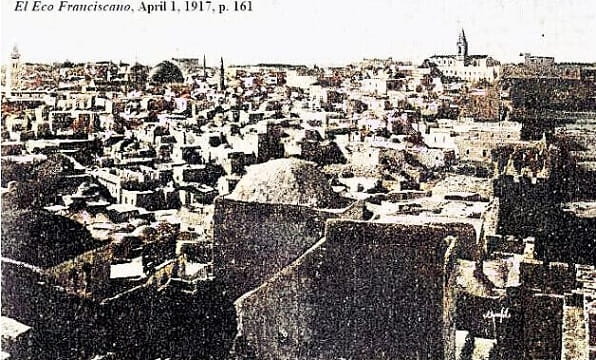
On December 8 the English forces attacked Turkish positions located west of Jerusalem. Welsh and English county troops advanced from the hamlet of Bethlehem, repelling the enemy, skirted the Holy City on its eastern side and parked on the road to Jericho. Simultaneously Londoner infantry battalions and dismounted Cavalry troops attacked the strong Muslim positions situated to the west and northwest of Jerusalem. The Cavalry maneuvered in haste and went to camp for the night on the road that leads from Jerusalem to Shechem. With these deployments the Holy City was left completely isolated and shortly thereafter surrendered to General Allenby. He and his general staff along with several British politicians, the British governor of Palestine and representatives of France and Italy awaited on a mountain track the safeguarding of the city and its Holy Places.
The day before yesterday the English general accompanied by commanders of French and Italian contingents and by the heads of the French political mission entered Jerusalem officially.
The taking of Jerusalem was delayed to avoid damaging the Holy Places, the city or its environs. Great care was taken to that end.
September 27, 1918. El Correo Gallego, year XLI, number 14738, page 2.
London. The Reuters Agency correspondent in Palestine recounts the warm welcome enjoyed by the British troops in Haifa, even from the German colony for it endured much pillage from the Turks. Nearly all the German colony is Württemberger.
Perfect calm reigns over the city. The British have taken charge of the municipal administration.
The number of prisoners made by the Allies poses a serious problem. Many prisoners drop exhausted on the road. They are picked up by the wagon drivers and dumped inside. The procession is endless, a German general is one of the prisoners. The loot garnered is considerable. It includes several coffers of Turkish banknotes.