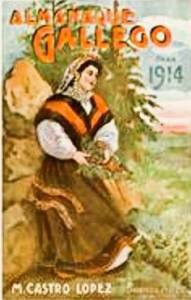
Almanaque Gallego (para el año 1914), year XVII, pages 60-62. Manuel Castro López con la colaboración de distinguidos escritores y artistas. Buenos Aires: Talleres Heliográficos de Ricardo Radaelli.
The Synagogue. When there were more than ten Jews over thirteen years old in a town they searched for a house suitable for making it over as a synagogue where to meet and recite daily prayers. The members of a prominent community did not tarry, they constructed a temple, furnished it with the sacred books and with all that is required for the three components of a spiritual life: prayer, meditation and reading.
It must be pointed out that Galaico-Portuguese Jews referred to a "Sinagoga" as the "Esnoga"; we'll use both terms interchangeably.
It ought to be known as well that Jews who settled in the Galician region, plying their trade and commerce primarily in cities and villages like Betanzos, Monforte de Lemos, A Coruña, Ourense, Pontevedra, Celanova and Ribadavia, were not, as a rule, segregated in ghettos or aljamas but commingled with their Christian neighbours until a feast of the Mosaic Law congregated them before the Rabbi. However there were some exceptions to this rule. Some villages like Allariz did segregate them.
The Esnoga had to be built on the highest point of the Jewish quarter. No one dared to build his house taller than the temple or too far away to see it.
The beit Midrash, the spot in the Synagogue where prayers were read and offered to God, was prioritized for habitation. This was a space of great sanctity which could not be dedicated to a separate use, so much so that a Esnoga could be turned into a beit Midrash, but a beit Midrash—being the holier of the two—could not be turned into a Synagogue.
The temple's entrance faced the Echal, where the Sefer Torah scrolls are kept along with a lectern (Tebá).
Upon the sale of a Synagogue the first expenditure from the yield was reserved for the purchase of the five books of the Law plus the writings of the prophets. If these were ever sold, the proceeds could only go to purchase a Sefer Torah and any cash left over had to be spent on something endowed with greater sanctity, according to what Menasseh-ben-Israel says in his Thesouro de los Dinim,
Money obtained from the sale of Nedabá or Ribbon must be reserved for the construction of a Esnoga or the furnishing of a beit Midrash, for the purchase of a Tebá or frills for the Sefer or the Sefer itself. If they should change their mind or forget to spend the money, they must spend it on something worthier than originally planned.
Holding to the principle of selling an item of lesser sanctity to buy another one of greater, the Jewish sages hold that a Synagogue with all its sacred objects—including the Sefer—may be sold to redeem captives, to marry orphans or to sustain the upkeep of the Talmud Torah because according to Hachanim whoever can explain the Sefer must be held in greater esteem than the sacred book itself.
Ornaments of silver donated by devout Jews to the Synagogue could not be sold toward the purchase of anything profane. The Kaal accepted donations for safekeeping, treating them as part of the temple's holy treasures.
The Sefer was clothed in a rich fabric embroidered with gold, silver or precious stones even, and this custom persists today in Synagogues of foreign communities abroad, but this cloak or cape could not be woven from fabric previously used for a profane task.
If a member of the "Esnoga" pledged to pay a Misvá (gift of cash or deferred payments) and then cancelled the pledge because of a sudden misfortune the Kaal could exact his pledge from another member of the congregation subject to a full refund if the financial situation of the initial donor improved sufficiently.
The Synagogue was as holy as everything that belonged to it. As in Christian temples propriety was a must: no eating, drinking, rambling, chatting, dozing, etc. Nevertheless the talmudin or caretakers could lay down to sleep on the midoasin.
Out of respect for such a sacred place one could not enter the Synagogue merely to seek respite from winter's cold or summer's heat.
The money boxes for Tzedakah or for the redemption of captives, alms and other offerings usually found in the temple, could not be opened and the amount of cash tallied. Nor were funerals and exequies celebrated in the Synagogue unless the dead person had been an eminent individual widely admired.
It is also forbidden to take a shortcut by crossing two doors of the Synagogue, but the practice was lawful after doing Tefilá (praying).
When somebody dropped by a Synagogue it was mandatory to recite a psalm before leaving so as to confute any gossip that the visit had a profane motive.
One must never enter the Synagogue with head covered and any dust or dirt on one's clothes or shoes must be wiped off before entering.
The Synagogue was always clean, mopped and its candles lit to magnify and honour the Mosaic cult.
Worn-out Sefer mantles, Mezuzot (Shema Israel verses), Tefillin straps, the Echal or its curtains, the lectern, went to a clean storage room as sacred objects. Eventually they were fastened to the burial shroud of former Synagogue attendants.
A timeworn Sefer Torah was disposed of by sealing it inside an earthenware vessel and burying it in the grave of a Talmid [disciple].
A wax candle taken from the house of an idol-worshiper could not be lit inside the temple.
If a mouse drowned in the Synagogue's jug of oil, all the oil had to be discarded.
The stub of a Synagogue candle could be taken home and used for reading but never to light a regular candle, for its flame would be defiled.
Benito F. ALONSO
Orense, 1913