September 9, 1907. La Correspondencia Gallega: diario de Pontevedra, year XIX, number 5273, page 1.
Holland hosted the eighth Zionist Congress a few days ago in "Geborwnvoor Hunsten" (?), a city situated close to The Hague.
The Zionists are those Jews who work to resurrect the Jewish State in Palestine in all its ancient splendor.
Four hundred delegates attended the Congress. Mr. Max Nordau the notable propangadist of Zionism explained that the Zionist movement is the Jews' response to antisemitism and it purposes through the creation of a Jewish State in Palestine to end the oppression and misery endured by Israelites in most nations and to guaranty them a normal means of living. Zionists must unite to show the world what they want and what they can do. Unity would spur civilized States to confer together and devise a solution to the Jewish question.
The congress unveiled two factions: one political, another pragmatic.
The more numerous political Zionists led by Max Nordau pretend to create a Jewish State in Palestine with the Powers' permission induced by a global union of Jews.
Pragmatic Zionism obviates that dicey consent and instead urges the intensification of emigration to Palestine in order to ensure the possession of the land and the expansion of agricultural colonies.
The main resolutions passed by the Congress were the following:
The Zionist movement is far from having the importance which some adherents ascribe to it. Jews have already overcome the prejudice that set them apart in the civilized countries, they are no longer treated like pariahs. Instead Zionism might trigger a new isolation of the Jews from the rest of the world and revive the old prejudices which today seem forgotten. Wherefore most wealthy Jews prefer to remain subjects of the nations where they live rather than become citizens of Palestine. Their adherence to Zionism was shown at the current Congress only by the offer they made of enormous sums of money for the comfortable settlement of impoverished Jews on some territory of America or Oceania. However the Zionists rejected the offer as they did England's of vast territories in Uganda some years ago. Zionism is adamant on this point: it's either the establishment of a Jewish homeland in Palestine or the continuation of an errant existence.
December 1, 1909. El Eco Franciscano, revista quincenal ilustrada, year XXVI, number 390, pages 770-771.
According to the [Augustine] Fathers of the Assumption, Palestine has the same area as Belgium, i.e., thirty thousand square kilometers, and in the monarchy of Solomon it had a population of eight million. Thus its ancient population density was greater than the population density of any country in the world today, evincing the lavish life that Palestine enjoyed in Solomon's day. Today the net population of Palestine, native plus European, does not reach one million (p. 770).
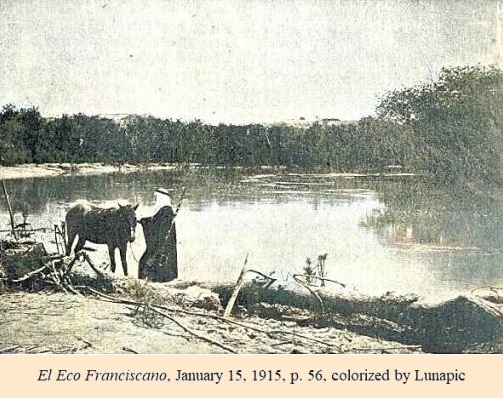
There is not a single town in an area of eight hundred square kilometers about Caphernaum. Bethsaida, Magdala, Korazim, Julias, Gerassa, etc., are today nothing more than a pile of ruins covered in brush.
The countryside between Caphernaum and the mouth of the Jordan River can not be traversed without the real peril of being devoured by beasts—in contrast with the flocks of blackbirds that gladden and enliven it.
Last March we crossed it and had an awful fright when we chanced upon five hefty hyenas. We backed away instinctively on seeing them. However the Bedouin who accompanied us, rifle slung over his shoulder, encouraged us saying that they did not attack during the daytime, and so we proceeded on our way without incident (p. 771).
In 1900 they [the Franciscan Fathers] put up two small provisional cabins there [i.e., on the overgrown site of Caphernaum's ancient synagogue], one cabin was for the labourers and another for the clergyman in charge of the planned excavations. But who today among the Franciscans of the Holy Land will possess the courage to settle amid the ruins of an ancient city overgrown with brush? full of scorpions and every species of snake? spattered with wellsprings of pestilence dredged naturally by the lake's drainage? without companionship for many leagues round other than the wild beasts roaming free and the Bedouins, armed to the teeth, who make the rounds of that lonesome wasteland from time to time? (p. 771).
January 1, 1910. El Miño, es el diario de mayor circulación de la provincia, year XIII, number 3306, page 1.
The Jews dispute the verdict that close to two thousand years ago sentenced them to live without a fatherland.
Today Zionism—which we could tab Jewish nationalism—begins to manifest the first signs of a body whose aim is to reunite the Jews for settling the promised land, the land between the Euphrates and Egypt.
Zionism was started by Herzl twelve years ago in Germany but its defenders say that it is still far from having gelled all the Israelites of the [German] Empire into a national movement.
The present Zionist Congress of Hamburg has not garnered the universal approval of Jews. Ads taken out by prominent Israelites in some Hamburg newspapers attest to this. The ads state that the majority of German Jews opposes Zionism vigorously and that hardly a hundred thousand out of twelve million Jews worldwide endorse it. Only six thousand eight hundred German Jews (out of a constituency of six hundred thousand) are Zionists. A sizeable fraction disputes the movement's political takes and merely endorses the efforts to colonize Palestine. That's why—say the ads—the German Israelite community has declined to take part in the Congress. The congress convened just three hundred and fifty-two delegates.
The Jewish masses do not want to dissociate themselves from the rest of society other than religiously. Thus a Jew wishes to be a German in Germany, a Frenchman in France and a Belgian in Belgium. He seeks no national identity apart from his country of residence.
Hence the rift with those who essay to awaken the historical ideal of a national Jewish consciousness.
Max Nordau the renowned president of the Hamburg Congress has pinned down the significance of Zionism with greater clarity:
Zionism is a movement whose objective is to provide unconditionally a secure home in Palestine for all Jews living abroad among the nations of the world who can't or won't assimilate.
If this class of Jews asks for a permanent homeland in Palestine it is not to dwell there as naturalized foreigners or as tolerated guests but as heirs to a Jewish national life that was quashed 2,000 years ago physically but preserved consciously.
Zionism is nonexistent in France but it teems in Russia among the intellectuals and the proletariat.
According to Max Nordau the most forceful opponents of Zionism are those affluent Jews who defer every ideal to social ambitions,
These call themselves French, German or British with the same sense of right as natural citizens or natives. They do not forgive us our attempt to resurrect the Indian (? perhaps indigenous?) nation.
Another one of Zionism's most powerful foes, beside those unforgiving Jews, will be the Turkish State.
The Ottoman Empire, notwithstanding the advent of the Young Turks, who are infinitely more tolerant than the ancien régime, realizes that the creation of a Jewish nationality risks increasing the number of eclectic factions and races in it. That's why it refused in several occasions to sell large tracts of Palestinian land to the Zionist Bank despite the bank's juicy offers. Aware of the problem, the Zionists opted to make agricultural colonies the national hub of their primordial country.
Many wonder whether Zionism will be able to overcome the hostility of fellow Jews and eventually create a Jewish fatherland.
February 15, 1910. El Eco Franciscano, revista quincenal ilustrada, year XXVII, number 395, page 118.
I am here in this Orient, cradle of Christianity, theater of all the centuries' greatest events since it witnessed the glorious deeds of famed Josuah the leader of the people of Israel. Since that campaign of conquest to our present day this Orient has not lost its allure.
Thus we first see the Syrians or the Babylonians, the Pharaohs next, Alexander of the Greek Empire, the generals to whom he bequeathed his vast domains, the Maccabeans and their epic feats, the Romans, the Crusaders of the Middle Ages and now the flourishing nations of Europe, all have set their sights upon this aforetime fertile territory, emporium of civilization and industry, but which in Turkish hands today we behold deserted.
Because of the Sultans' nonchalant administration or because of the neglect manifested by the municipalities or because of sloth on the part of Mohammed's followers we behold the fecund plains untilled, unopened the rich mines ensconced deep inside the long mountain ranges that gird Palestine, without the prospect of a single miserable factory to substantiate the presence of some enterprising soul.
FR. ALEJANDRO TORIBIO
September 5, 1911. La Voz de la Verdad, diario católico antiliberal con censura eclesiástica, year II, number 277, page 2.
The [tenth] Zionist Congress held in Basel discussed revising the movement's statutes, giving it a final framework.
When the point on Jewish emigration was raised a Russian delegate declared that a million eight hundred thousand Jews had emigrated to the United States over the span of twenty-five years and that another four hundred thousand had emigrated to other countries. The same delegate said that a way of channeling the emigration to Palestine must be found in order to avert a dispersal of the race, for currently only two thousand Jews on the average move to Palestine every year.
The congress proposed to set up an Emigration Committee in Berlin after the review and approval by an eight-member committee.