
March 20, 1902. Boletín oficial eclesiástico del Obispado de Lugo, year XXX, number 8, pages 113-14.
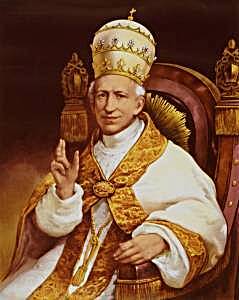
With sweet solace we have received the news that the Workers' Patronage which, under the care of St. Vincent de Paul, exists in that city of Bilbao and which is preparing to undertake a holy pilgrimage from the Spanish region of Cantabria to Palestine for the purpose of visiting those Holy Places sanctified with the divine Blood of Jesus Christ and of manifesting there the enormous love they profess for their Divine Redeemer doing penance together and reciting prayers for his love.1
Being well acquainted with the copious and well-seasoned fruits of Religion and piety that have always been harvested by similar French pilgrimages conducted by the Augustine Fathers of the Assumption, we have felt enormous joy at seeing Spaniards binding their efforts together for bringing about such a fruitful and holy endeavour.
Who knows if, on witnessing these very noble examples, all other Christian nations will feel compelled, as it were, to vie for a pew at the sepulchre of mankind's Redeemer to render him fealty and adoration!
May 2, 1902. Boletín oficial eclesiástico del Obispado de Lugo, year XXX, number 12, pages 179-190.
Tuesday April 1.
On a Barcelona pier two hundred and twenty-six pilgrims embark the magnificent English steamer, Midnight Sun. The bishops of Lugo and Astorga are among the passengers. The Most Eminent Cardinal of Barcelona came briefly aboard to bless the vessel. We sail away singing the popular Salve Regina on a gorgeous sea slightly ruffled by the wind.
Wednesday April 2.
Shortly after waking we exited the cabins for the deck and became acquainted with the daily schedule on board. Masses every hour. 7:30 AM, first half of the Rosary. 8:00 AM, breakfast. 11:00 AM, second half of the Rosary. 11:30 AM, one hour allotted for removing personal effects from the ship's hold. 12:30 PM, lunch. 4:00 PM, tea. 5:00 PM, Vía Crucis and homily. 7:00 PM, Rosary and blessing. 7:30 PM, dinner. 10:00 PM, lights-out. There was also a notice that said, "The concerts will be held after lunch and after dinner."
This morning many passengers get seasick.
On deck at 3:00 PM we were handed the white hats that we must wear during the excursions in Palestine.
After dinner the ship's captain dropped in for the evening concert. The emcee greeted him with the traditional British catchphrase, "Three cheers for the captain: Hip, hip, hip" and the auditorium answered enthusiastically, "Hurrah!" The sextet then played the British national anthem to loud applause at the end.
Following the concert the captain, gratified and visibly moved, addressed us with these words which I translate literally,
I am very grateful for the attentions you have showered upon me, and I take the opportunity to welcome you aboard this good steamer, the Midnight Sun. I also take advantage of the occasion to congratulate the ladies and gentlemen who were brave enough to come down to the salon in such great numbers, giving me well founded hopes that upon our arrival to Haifa you will all debark like veritable mariners. Now, in reciprocity to your courtesy, I beg you to let me hear your national anthem as a token of my gratitude.
Tuesday April 8.
No one was able to sleep soundly. Before 3:00 AM people begin to gather on deck. Starry sky from end to end. The Haifa lighthouse can be glimpsed in the distance. Disembarkation proceeds swiftly thanks to our admirable orderliness praised by everyone watching. Upon landing everybody kissed the ground.
We immediately went to visit the Latin parish church and later we crossed the idyllic plain of Haifa along magnificent roads.
We walked up Mount Carmel and lunched at Abdala Tower. A Turkish band conducted by a Carmelite Father played the Royal March of Spain and the March of St. Ignatius which is the hymn the pilgrimage adopted. Both elicited warm applause.
After lunch we visited the Carmel and later descended for the road trip to Nazareth.
We crossed Haifa and entered the plain of Acre. We skirted Mount Carmel and passed through the prairie of Esdraelon whose fertility we marvelled at. On the way we stopped to drink an orange refreshment.
In the evening we passed by the land of the Zebedees where there stands a church built by Spaniards.
As night fell we arrived to Nazareth.
After visiting the Church of the Annunciation we ate dinner together underneath a huge canvas, everyone in superb humour.
We retired to sleep either in Casa Nova, in the convents of St. Joseph or of the Apparition, in the German Hotel or in the Hotel of Nazareth.
Thursday April 10.
We rode on horses and donkeys from Nazareth to Mount Tabor. The sights along the route are of a manifold variety. I could fill a whole book describing them.
Mount Tabor is gorgeous, nay, more than gorgeous. Many would have liked to put up tents there like St. Peter and never come down.
We toured the ruins of the ancient Benedictine convent, the Crusader fortresses and Josephus' bulwarks.
At length we remounted our steeds. After a short while we chanced upon a caravan of 1,300 Russian pilgrims who, with their popes at the head, were starting the climb.
What an admirable and uplifting spectacle. Men and women, mostly on foot, carrying clothes and food, seeking the shade of trees, and watching us pass them by with affection—yes, as we did them—despite observing a different religion. After all we were going to honour the same God! How much we who travel with so many comforts must admire those unhappy souls! May God touch the hearts of those unfortunate ones and may the days of unity come quickly!
Friday April 11.
Tiberias! Two Masses were celebrated concurrently, one at the parish church of the Franciscan Fathers and the other at the adjoining small Greek church. In this last church, outwardly impoverished, a fence separates the men and the women.
After both Masses the pilgrims spilled over the village. They visited the Mosque—full of cheer this being a Friday—the Synagogue—whose Rabbis showed us magnificent manuscripts of the sacred books preserved in rolled-up parchments [scrolls]—the Greek church, the Bazaar, the Marketplace, etc.
We lunched at 11:00 AM and afterward sailed the sea of Galilee in a flotilla of barges which later broke up in bundles.
The sea of Galilee lies two hundred meters below sea level. It was flat, beautiful and gorgeous as we put out to sea, and the voyage to Caphernaum was very enjoyable indeed, but a strong wind arose before the return to Tiberias which prevented a docking for nine barges. Remembering the Apostles' "Save us, Lord!" incident, it was thought prudent to have all the barges sail together to another wharf at Bethsaida and step off there. This was done successfully.
After separate hikes on land some pilgrims walked back to Tiberias, others rode horseback.
Sunday April 13.
After lunch in Tiberias we boarded cars and headed back to Haifa. The trip that had taken us six hours coming now took three and a half going because the drive is downslope and because the heat of previous days had slackened.
As soon as we arrived in Haifa we embarked with consummate orderliness and happiness.
We stay anchored facing the Carmel until ten o'clock in the evening. Pilgrims pray the Rosary in groups scattered over the deck or fill the time writing to their families.
May 10, 1902. Boletín oficial eclesiástico del Obispado de Lugo, year XXX, number 13, pages 195-207.
Monday April 14.
At 4:30 AM the Midnight Sun anchored near Jaffa's shore.
The official welcoming boats and others hired to transfer us to dry land began arriving as soon as the sun first shone upon us.
It is said that Jaffa's boatmen are the best sailors in the world, and definitely they must be, for they wove their way safely past the countless rocks that encircle the harbour, some sticking out of the water, others lying treacherously beneath the surface of the sea.
We did not have to go through Customs and at 7:00 AM all pilgrims had gathered inside the parish church of the Franciscan Fathers. These treated us later to a magnificent lunch in the mess hall of their convent, a welcome respite from campground chow.
After lunch the pilgrims split up and boarded two separate trains bound for Jerusalem a quarter of an hour apart. We took the first one.
We were welcomed at Jerusalem's railway station by the Consul General of Spain, the Communities of the Franciscan Fathers and the Sisters of the Holy Rosary together with their schoolgirls. The railway station is located far from the city.
As soon as the second train arrived we formed a procession headed by four janissaries in their showy uniforms followed by the Spanish flag, the ladies in double row, the gonfalon of the pilgrimage, the gentlemen, the priests and the prelates, the Consul General and the director. The procession parted singing psalms, the Rosary and the Litany of the Saints. At length we entered Jerusalem through the Jaffa Gate under the gaze of an immense crowd.
Tuesday April 15.
After eating breakfast at Casa Nova those who lodged there, or at Our Lady of France those hosted by the Assumptionist Fathers, we headed out in groups to tour au touriste, as it were, the Holy Sepulchre, its sanctuaries and offices.
It is a painful truth: there's nothing there that is appealing but the site's holiness and its reminiscences. One can not conjecture a greater neglect or abundance of filth or lack of reverence for the holiest place on earth.
As a byproduct of the status quo set by the Powers no bolt may be used, stone displaced or disrepair rehabilitated. Consequently the vaults shell, the walls grime and the tiles chip.
The moral impression is as dismal as the physical. The Orientals enter and leave the precincts with their head covered, as is their custom. Some smoke, others chat, many lie sprawled about on the floor. Discussions and colloquies fill the air. The Greeks set up booths for selling religious souvenirs, wax, etc.
After lunch all the pilgrims gathered for the visit to Mount Moriah.
It's impossible to convey the wonder caused by the magnificent and marvelous mosque with its wealth of features. All hearts sank on comparing the majesty of the Al-Aqsa Mosque to the squalor of the Holy Sepulchre Basilica.
We visited the orchard of Gethsemane, property of the Franciscan Fathers. The fathers have turned it into a precious garden, and also the spots where the apostles slept, Judas gave the kiss of betrayal and St. Stephen was stoned to death. On this last location we had to walk between rows of disgusting lepers who aroused everyone's compassion.
Wednesday April 16.
By 6:45 AM all pilgrims had gathered for the drive to the poetic village of Bethlehem.
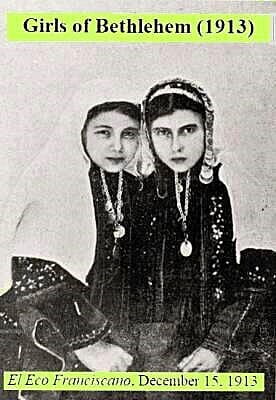
We were distributed among some fifty automobiles.
On the way we passed by the monastery of St. Elijah, property of the schismatic Greeks. From its heights one can contemplate the lovely village of Bethlehem off to one side, and the domes, minarets and towers of the deicidal city off to the other.
We arrived in Bethlehem at 8:00 AM and immediately went to hear a solemn Mass sung at the Church of St. Catherine.
Afterward we visited the village's sanctuaries, first the recently restored Milk Grotto converted into a precious chapel.
We went to behold the Field of the Shepherds; some pilgrims descended all the way, passing by the grotto of St. Joseph's workshop, which is similar to the one in Nazareth.
We also saw the fields of Boaz where the idyll related by the Book of Ruth unfolded.
Afterward the pilgrims purchased many souvenir rosaries, crosses, etc, in the handicraft shops.
We ate a magnificent lunch at the convent of the Franciscan Fathers and we returned to Jerusalem in the afternoon. Taking the road to Hebron we went to visit the famous Pools of Solomon.
Back in Jerusalem we dined and afterward went in procession to Our Lady of France whose church was admirably decorated with more than a hundred electric lights.
Thursday April 17.
At as early an hour as yesterday's we travelled from Jerusalem to "St. John of the Mountain" [Ein Karem].
The drive lasted forty-five minutes. Our first visit was to the sanctuary of the Franciscan Fathers. The coat of arms of Castile & León tops the arched entrance to the church and embroiders the chasuble of officiating priests also.
Upon arrival a Mass was celebrated and the Benedictus sung.
After visiting St. John's Chapel we removed to the dining hall of the Fathers where they served us an appetizing lunch with the affection of Franciscans and Spaniards. It's so delightful to discover an essentially Spanish nook here—a thousand leagues away from the fatherland and in these Holy Places—where all hearts beat in unison and all tongues speak the same language!
After completing our tour of the sanctuaries we returned to Jerusalem at 3:00 PM, ruefully leaving so Spanish a niche behind.
Friday April 18.
Gorgeous day! At 7:00 AM solemn Mass.
At 9:00 AM we performed the Via Crucis along the Doleful Street [Via Dolorosa] shouldering the two hefty crosses of the pilgrimage. We actually did the first station in the parade ground of the Turkish garrison.
How much could anticlerical Spaniards learn from the Turkish Muslims! There, as along Doleful Street, not only were we not harassed but actually encountered all manner of courtesy and respect.
After lunch we went to the spot where Jews weep, and we found a great number who, book in hand, recited their lamentations, foreheads resting on the colossal stones which are the remnants of Solomon's construction.
Once in the Jewish quarter we visited the two best synagogues of Jerusalem, the German and the Spanish one.
At 7:00 PM we congregated on Calvary. We heard a sermon and sang Ledesma's Stabat Mater played by the sextet of the pilgrimage.
It is incumbent to pay homage to our female pilgrims. Neither the weight of the two crosses which they bore with respect and gladness, nor the intensity of the searing sun, nor the press at Calvary where no seat was to be had, nor the fasting, nor the silence, could break their sturdy and pious disposition, and today they are cheerful and happily satisfied with what they did, yet willing to do much more.
As the Prelates said, one can go to the end of the world with someone who always dons a smile and disports a merry soul.
Saturday April 19.
The morning was left free for pilgrims to do as they wished; and so Jerusalem's central neighbourhoods were full of life and the white veils of our hats and red bows on our arms were visible everywhere.
At 11:00 AM we gathered for lunch, and at 12 noon we left Jerusalem on a two-day trip to the Jordan River and to the Dead Sea, sleeping overnight in Jericho.
We crossed the Desert of Judea by car and made a stopover at Khan el Ahmar the site of the parable of the Good Samaritan.
We also paused briefly on a hill to contemplate the picturesque Greek Monastery of St. George suspended 'twixt heaven and abyss in the embrace of the desert's solitude.
With the afternoon half spent we reached the small hamlet of Jericho, crossed it and went to Elisha's Fountain where we refreshed ourselves. Frankly, though, the heat was on this day quite bearable.
We parked the cars by Elisha's Fountain and walked to the "Mount of the Forty Days" [Mount of Temptation] which we ascended with plenty of vigor despite the abruptness and steepness of the rise in order to visit the very curious Greek monastery compassing the cave where Our Lord fasted. From the height we beheld the immense plain of the Jordan.
The Greek monks gifted us with a refreshment.
We descended the Mount of the Forty Days, walked back to Elisha's Fountain, boarded the cars and returned to Jericho where we installed ourselves in these four hotels, Gilgal, Bellevue, Jordan and Du Care.
We dined together and immediately thereafter retired for the night, for tomorrow we must get up very early.
Sunday April 20.
It is better to pass over in silence the bad experiences, so I will not dwell on the nighttime sojourn when all the individuals of the pestiferous Palestinian fauna rendezvoused in every hotel room of Jericho. The mosquito nets and our exhaustion proved useless against an inhospitable swarm that left us with a souvenir of inexpungible itching and smarting.
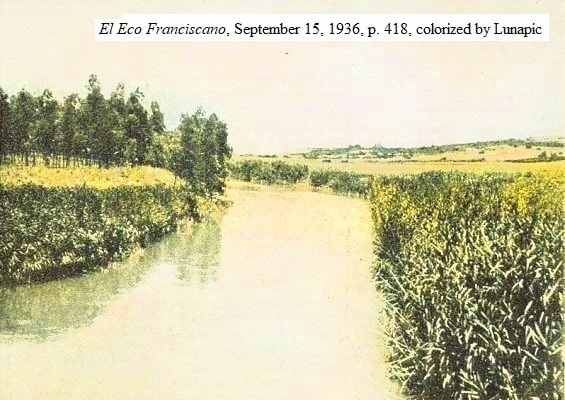
Thanks be given that the wake-up call sounded at 3:00 AM and that half an hour later we fled in cars by way of the Jordan River under a very lovely star-studded heaven.
The way of the Jordan, if it can be so dubbed, was the worst.
Jolts, lurches, bounds and many gulps of dust later, we arrived at length to a delicious spot on the bank of the River Jordan where we heard Mass and had a most picturesque picnic-style breakfast.
After their consumption of breakfast some pilgrims opted to cruise the historical river leisurely aboard the only existent ferryboat.
After everyone had consumed their breakfast we drove to the Dead Sea, not experiencing the sweltering heat that usually hangs over those pits but relishing instead a very agreeable temperature. Hence the aspect of the Dead Sea did not give us the sad impression which so many other travellers report. Still life and vegetation are indeed absent there. Over the entire expanse of the sea only one barge was visible. It flew the Turkish flag, transported salt and had been hauled there recently.
We lunched at 10:30 AM under the tent and then drove back to Jerusalem, retracing yesterday's route.
Now the air was getting hot and some fatigue set in. Nevertheless pilgrims stopped at different places along the way as they saw fit.
At twilight all pilgrims gathered in Casa Nova, including the dozen or so who had opted out of the expedition to the Dead Sea (which really does not redress its ordeals despite our being very lucky).
May 20, 1902. Boletín oficial eclesiástico del Obispado de Lugo, year XXX, number 14, pages 218-224.
Monday April 21.
It rained until 7:00 AM. Some pilgrims qualified the cool temperature brought by the rain as genuine cold.
The final religious ceremonies held at the Church of the Saviour ended with the imposition of the cross medallion ordained by His Holiness for Holy Land pilgrims. The rest of the day was left free.
After the 5:00 PM dinner a good-sized number of pilgrims attended the official reception given by the Spanish Consul General in the salons of the New Hotel to commemorate our pilgrimage. The whole diplomatic corps of Jerusalem was there. The reception ended after midnight.
Tuesday April 22.
Early in the morning we ascended the Mount of Olives to the ceremony honouring the emplacement of a plaque with the Our Father prayer engraved in the Basque language [euskera]. Although the plaque had in fact not arrived the ceremony went ahead anyway.
After a 10:00 AM lunch we headed out in procession to the railway station.
Farewell, Jerusalem! With what sadness we leave you—many destined to never see you again—and most of us with the intention of visiting you once more before we die!
We departed Jerusalem at noon aboard two chartered trains. They brought us to the seashore in around three hours.
Boarding the Midnight Sun proceeded right away.
Tuesday May 6 to Friday May 9.
Fairly strong gale, very rough seas.
The waves sweep over the deck but fortunately the Midnight Sun is a "good steamer" and our captain an expert mariner.
Saturday May 10.
We have docked in Barcelona. Back in the fatherland once more after so long a pilgrimage.
October 20, 1902. El Áncora, year VI, number 1533, page 3.
According to reports from Palestine cholera is causing many victims in Jaffa and Gaza and is spreading to other towns.
November 5, 1902. El Áncora, year VI, number 1546, page 2.
Paris, 3. Telegrams from Jerusalem say that the authorities have vacated their posts due to the cholera epidemic. There are no medical aids or basic commodities. Four hundred and ninety-four deaths were registered over the past week in Gaza, seventy in Lydda and five in Jaffa.
January 17, 1905. El Correo de Galicia, year VI, number 1236, page 3.
A Jewish member of the German Parliament erupted in insults toward the Catholic Religion but the President called him to order saying that since the great proportion of the Chamber was Christian he would not brook having their religious feelings offended in any way.
October 6, 1905. El Correo de Galicia, year VI, number 1449, page 1.
The legendary Wandering Jew, the hapless Ahasuerus, is the hallmark of the Jewish people sentenced for their fearsome crime of deicide to abide on earth without ever recovering their lost nationality.
Howbeit this stubborn people does not abandon its golden dream of a new Jewish Jerusalem like the one Roman emperor Titus conquered after a very cruel war.
We believe that El Correo de Galicia readers will view with pleasure these curious data concerning the efforts of the Zionist Jews. We translate and extract them from La Libre Parole.
The Jews call themselves thrice French in France, thrice German in Germany and thrice British in Great Britain. Withal they maintain an indelible commitment to their race everywhere and stay Jewish above everything else.
The efforts spent in modern times to rebuild a Jewish nationality (setting aside the failed attempt of Julian the Apostate) hearken back to the year 1850 with the creation of the Alliance Israélite Universelle.
Even before the creation of that society named Alliance, Crémieux, Montefiore and other leaders of Judaism toured several countries to pick a territory for their future kingdom of Israel.
They toured Egypt, Palestine and Syria.
Since then the Hebrews, true to their favourite tactics, have not ceased doing the underground stealthy work of moles.
First they went around purchasing homesteads and thereafter whole Arab hamlets, so that presently they are the owners of almost all of Palestine.
A society with a start-up capital of 50 million French Francs and with one branch each in Jerusalem, Jaffa and Haifa, finances this invasion.
Jews dominate the cities. Out of Jerusalem's 120 thousand inhabitants 100 thousand are Jews; 23 out of 30 thousand in Jaffa and 9 out of 10 thousand in Tiberias.
January 30, 1906. El Correo Gallego, year XXIX, number 9334, page 1.
Really pitiable is the situation of Jews everywhere. The hatred nourished against them by the fanatical Christians of the Middle Ages based in the belief that the death of the Crucified had to be avenged on them has hardly disappeared with the passing of centuries, and today the ill-starred Jews are still victims of the cruel mob, of a most inhumane persecution.
Arab hurly-burlies, Armenian raids, Russia's revolutionary outbursts, the abuses of unruly Turkish soldiers, the Royalist spasms of France, all these prefer to comb the raggedy Jewish race for victims, and so Jewish blood runs for petty or looney reasons without Christian Governments bending to guarantee the security of a race that incidentally is far from trammelling the progress or prosperity of the countries where they reside.
If Jews were to feel some day the fire of vengeance coursing through their veins, if they were to flame with a desire for retaliation and set up centres of resistance, the conflicts they could vex feeble or bloodthirsty European governments with would not be small fry.
Because it is vital to inform those who still ignore it that five and a half million Jews (no less!) dwell in Europe, distributed by country as follows.
There are 300,000 Israelites in Asia distributed as follows.
The figures for Africa are these.
The number of Hebrews living in America does not surpass 250,000.
The above data come from a Hebrew statistical report and stand therefore well grounded.
Hence some seven million Jews are dispersed all over the world, enough to constitute a significant state.
And yet, disseminated all over the world, lamenting the vanished splendours, surviving almost by a miracle, suffering all sorts of abuse and contempt, the Jews live out a sad life of silent oppression under the dominion of Christianity or of Islam, both of which hate them unto death. One solace alone does the Hebrew find in his fate: the acquisition of as much wealth as possible, and to that end, he brings into play his feline patience, his insatiable ambition, his perseverance and doggedness against all odds—as if he wished thus to avenge the offenses, vexations, prejudices he endures from the enemies of his race continually...
Spain—once the genuine haven of Jews during the Middle Ages—is presently the nation that hosts the fewest for having been Jews the target of rigurous expulsion under the monarchy of the Catholic Kings. Withal the descendants of Spanish Jews stay faithful to the language their forefathers spoke as well as to the beliefs they professed, and so in France, in Italy or in Austria one can easily discern among the Hebrew constituency those Jews still tabbed Spanish.
It is high time for that animosity toward the Israelites to disappear because it shames the civilized countries that still feel it. France, being a republic, revindicates the hegemony of individual and collective liberty and wants to show its love and goodwill toward the race exiled from its own fatherland, and so French Israelites have their grand synagogue in Paris, and so several among them are creditors of the French State to the tune of several million francs; but this is merely gloss on the surface of officialdom because the Frenchmen of every social class loathe the Jew and bait him tyrannically when they chance upon a Dreyfus, guilty or innocent.
A few years ago a group of Israelites conceived the beautiful yet challenging task of attempting a multitudinous return to their ancient homeland, Judea the forsaken. This is purely a platonic ideal, as platonic as continuing to await the arrival of Messiah.
Not a few hurdles hinder this just and reasonable project. Palestine is in the hands of its latest conquerors, the Turks. Countries with a large Jewish constituency will not let their Jews depart because of the vigour and wealth they contribute. The creation of a state together with the apportioning of a territory as broad as seven million inhabitants stand in need of is an endeavour bristling with bloody conflicts.
The humanitarian and feasible alternative would be to end once and for all the persecution of Jews everywhere. The demise of antisemitic hatred would qualify as one of the most beautiful conquests of civilization.
R. I.
March 29, 1906. El Correo Gallego, year XXIX, number 9384, page 2.
The French steamship Campania left Vigo bound for Buenos Aires with nine hundred Jews aboard fleeing bloody persecutions in Poland. Entire families sail, framing a very sad spectacle.