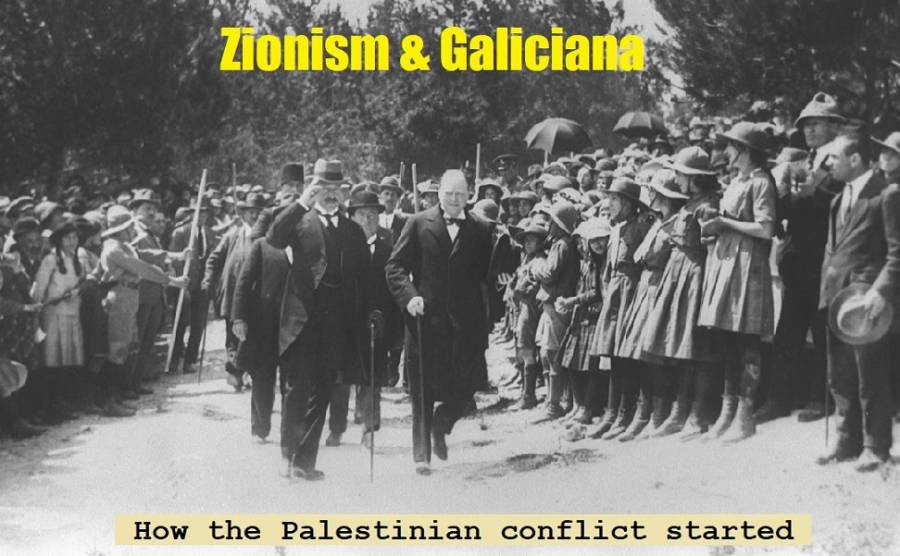
Author: Eduardo Freire Canosa
The object of this webpage, "Zionism & Galiciana," is to offer a novel backdrop to the gestation of the modern State of Israel. Selected excerpts from four classic Zionist works are juxtaposed with clippings of contemporary Galician newspapers.
The four Zionist authors are Moses Hess (1812-1875), Leon Pinsker (1821-1891), Theodor Herzl (1860-1904) and Ziv Jabotinsky (1880-1940).
Their classic works are "Rome and Jerusalem" (1862), "Auto-emancipation" (1882), "The Jewish State" (1895) and "The Iron Wall" (1923). The first three were originally written in German, and the fourth in Russian. The source of a translation to English or to Spanish is the Internet Archive for "Rome and Jerusalem," Araucaria for "Auto-emancipación," Masuah for "El Estado Judío" and the Jabotinsky Institute in Israel for "The Iron Wall." All Spanish text is translated to English by the author.
"Galiciana" is the name of the online Digital Library of Galicia. The website is managed by the Central Library of Galicia and is sponsored by the regional government. Xunta de Galicia launched the project officially on June 15, 2012. By the close of 2013 the digital library boasted more than 147,000 pages of monographs, charts and pamphlets, and more than 87,000 pages of historical Galician periodicals and newspapers. The access to the collection is free and open to everyone.
The government of Spain was not interested in the events of Palestine or the progress of Zionism over the historical period covered by this work, and secular Galician newspapers reflected this.
Only the Catholic press displayed keen interest in both topics after the fall of Jerusalem in 1917 and the onset of the British Mandate in 1919. The main concern of the Roman Catholic Church was its diminished influence in Palestinian affairs and the second-class status given to its enclaves and sanctuaries under the Mandate. Well-informed Galician newspapers and periodicals of Catholic stripe subsequently criticized Zionism sharply together with the unqualified British support for it.
Lengthy articles and news stories hearken back to events at least a hundred years old. The focus is on the plight of the Jews in Europe, on Judaism, Zionism and Palestine. This "News from Galiciana" section runs from April 10, 1813, to December 1, 1923.
Whether you are pro- or anti-Zionist or indifferent, the data presented, the news reports and the arguments given will probably rivet your curiosity.
IndexClicking on a number will take you to the corresponding chapter right away |
|
1. Years 1813-1859: Death throes of the Spanish Inquisition
2. Moses Hess 3. Years 1867-1882: The French haven 4. Leon Pinsker 5. Years 1883-1892: The British haven 6. Theodor Herzl 7. Year 1897: Zionist Congress in Basel 8. Years 1898-1900: What do the Zionists want? 9. Years 1902-1906: Diary of a Spanish pilgrim to the Holy Land 10. Years 1907-1911: Eighth Zionist Congress 11. Year 1912: Benito F. Alonso 12. Year 1913: The valiant Galician, the son of Jews 13. Year 1914: Benito F. Alonso (II) 14. Years 1914-18: The First World War in Palestine 15. Years 1919-23: The British Mandate of Palestine 16. Ziv Jabotinsky |
April 10, 1813. Los guerrilleros por la religión, la patria y el Rey, diario polémico-religioso de la Coruña, month IV, number 74, pages 195-96.
Adiáforo. You said prior some stuff about tolerance, Philaleto, wanting to insinuate that a bit of this philosophy seeps into the paper of the abbot of Valdeorres.1
Philaleto. Read what the pamphlet full of piffles says, Adiáforo, and you will see that on pages 43 and 44 its learned author stamps a dark libel on the good inquisitor Lucero, presents as fact that the Inquisition hangs Jews from the pulleys merely for being Hebrews and the abbot would like this Jewish people of today to be still the one of whom God said, "Israel is my son."
It is apparent that the good Doctor has not read holy Scripture much and that he stands in need of Franklin 2 teaching him a few lessons. If Jews are the sons of God they must be so through the flesh because they descend from Abraham, but what does the Apostle say? "Not all those tallied as Israelites are Israelites nor all those who descend from Abraham are his sons, but only they who receive the promises delivered by God to Abraham; however these branches are presently cut off from their trunk, propter incredulitatem fracti sunt" (Rom. II).
Who then gave our Doctor of new lights licence to tag "son of God" a people whom God censured for their disbelief and stubbornness? And why is this illuminato so generous to and so compassionate an advocate of the Jews when he should know, being a prelate, that neither the Church—so compassionate a mother—nor he himself, whom I presume prays to and intercedes before God for all pagans and heretics during his saying Mass, prays for the Jews?
Does he not realize that these are the most resolute and obstinate enemies of Christianity and that if they could but for a moment erase it from the face of the earth they would sacrifice all their wealth and cash to do so?
[...]
The Galician webpage adds that he was elected deputy for the Canary Islands to the liberal Courts of Cadiz in 1811. There he became notorious for his discourse against the Spanish Inquisition. This annoyed other Galician deputies, particularly the Bishop of Ourense. After the restoration of the absolutist monarchy in 1813 he was tried by a church tribunal—and acquitted. The Liberals returned to power in Spain between the years 1820-23. During this period Ruiz de Padrón got again elected to the Courts, this time as a deputy for the Kingdom of Galicia.In 1784 he embarked for America and visited Cuba first. Subsequently an Atlantic storm diverted his vessel toward the American coastline, and he ended up in Philadelphia where he met and conversed with two great illustrated men, Benjamin Franklin and George Washington. During his stay in North America Ruiz de Padrón wrote his first pamphlet against the Spanish Inquisition.
Back in Spain he doffed his Franciscan habits and as a layman won the competitions for curate of a Leonese parish in 1802 and for the post of abbot of Villamartín de Valdeorras in 1807.
February 15, 1850. Revista Médica, periódico de la Academia de Emulación de Santiago, year 1850, number 48, page 240.
The widespread use of jennet's milk in illnesses derived from lassitude or from thoracic diseases was initiated in France by a Jew during the monarchy of Francis I. This king felt surpassingly weak; the fatigues of war and intemperance whittled him down to a state of languor that worsened each day. The king was told about a Jew of Constantinople who had the reputation of curing this type of ailment. Francis I sent a letter to his ambassador in Turkey with the charge of bringing the Israelite physician at all costs. He arrived, and the only remedy he prescribed was jennet's milk. This remedy had an excellent effect and at once all the courtiers, male and female, took up the same regimen.
Wednesday December 24, 1856. La Oliva: periódico de política, literatura e intereses materiales, year I, number 94, page 1.
The situation of the Jews has improved markedly under the present government of Russia.1 Today they can send their children to institutes of privileged learning. Furthermore medical doctors and lawyers may become civil servants of the State, and the five-year exemption from military service will prove very advantageous to this class of citizens. The deputies who observe the Jewish religion will convene shortly in St. Petersburg to agree on various points for improving the lot of the Israelites.
Saturday July 16, 1859. Boletín para el clero del Obispado de Lugo, year 1859, number 29, page 1.
Since the Lord has wanted to make use of Moses to establish the Jewish religion, which is the first foundation of Christianity, the name of the holy Prophet and his writings are insufferable to skeptics, and for that reason they spare nothing to obliterate even his memory...
It is true that Jews and Christians have always regarded him as a great prophet. Why then maliciously deprive him of a glory that is rightly his, acquired long ago? All the more is that glory grounded when characters of truth are detectable in his text. He instructs us concerning the creation of the world, he transmits his sacred conversations with God and gives us the noblest idea of the Creator that human understanding can fathom. The text portrays the Creator's divine perfections in the warmest colours and prescribes laws full of equity and most capable of preserving unity and instituting good order. What is reprehensible about this? Should one mistrust a man who reasons so well and whose humbleness reaches the extreme of revealing his defects to us?
God makes use of Moses to lead a predilect people and authorizes his mission with the greatest wonders, those marvels he recounts in his books. Can this be a reason for treating him like an impostor when ours are more potent for regarding him as a holy Prophet? Can we with any justice refuse to believe him when he relates to us what he has seen and done, especially when a great body like the Jewish nation attests on his behalf?
[...]
From the time that Innocent III evolved the diabolical plan to destroy the moral stamina of the Jews (the bearers of Spanish culture to the world of Christendom) by forcing them to wear a badge of shame on their garments, until the audacious kidnapping of a Jewish child from the house of his parents (which occurred under the government of Cardinal Antonelli) Papal Rome symbolizes an inexhaustible well of poison to the Jews. It is only with the drying-up of this source that Christian German Anti-Semitism will die from lack of nourishment (p. 35).
The great teachers of the knowledge of God were always Jews. Our people not only created the noblest religion of the ancient world, a religion which is destined to become the common property of the entire civilized world, but continued to develop it, keeping pace with the progress of the human spirit.
And this mission will remain with the Jews until the end of days, i.e., until the time when, according to the Promise of our Prophets, the world will be filled with the knowledge of God. The "end of days", so often spoken of by the Prophets, is not to be understood to mean, as some misinterpret it, the end of the world, but it denotes the period when the development and education of humanity will reach their highest point (pp. 47-48).
It seems that on account of the hatred which surrounds him on all sides, the German Jew is determined to estrange himself from Judaism as far as possible, and endeavours even to deny his race. No reform of the Jewish religion, however extreme, is radical enough for the educated German Jew. But the endeavours are vain. Even conversion itself does not relieve the Jew from the enormous pressure of German Anti-Semitism.
The German hates the Jewish religion less than the race; he objects less to the Jews' peculiar beliefs than to their peculiar noses. Neither Reform nor conversion nor emancipation throw the gates of social life open to the Jew, hence his anxiety to deny his racial descent (pp. 58-59).
To our educated German Jews, the feeling of hatred toward the Jews displayed by the Germans has always remained an unsolved puzzle.
Was not the entire effort of German Jews since the days of Mendelssohn directed toward becoming wholly Germanized, to thinking and feeling as Germans? Have they not striven carefully to eradicate every trace of their ancient nationality? Have they not fought in the "War of Liberation"? Were they not Teutomaniacs and French devourers?
Did we not chant but yesterday with Nicholas Becker, "They shall not possess it, the free German Rhine"? 1
Did I myself not commit the unpardonable stupidity of sending a musical composition of this "German Marsellaise" to the author of this song? And yet I had to feel personally the same disappointment that German Jewry in general experienced after it had given repeated demonstration of its patriotic enthusiasm. I also had to experience the sad fact that the German to whom I, glowing with patriotic emotion, sent my manuscript not only responded icily but, as if to fill the cup of bitterness to the brim, wrote in disguised script on the reverse of his letter the words, "You are a Jew."
I forgot then that Germans not only discriminated against the Jews after the War of Liberation but even persecuted their erstwhile comrades-in-arms against the French with the frequent cries of Hep, Hep.
I, on the other hand, mistook Becker's Hep Hep for a personal insult and wrote him a letter accordingly in undisguised script making a few unpleasant remarks, which this honest German passed over in silence, most likely feeling ashamed of his rudeness.
Today I could have apologized to this German poet for, as I see clearly now, it was by no means intended as a personal insult (pp. 71-72).
The Teutomaniac loves not the State but the dominance of his race in his love of the Fatherland. How then can he conceive granting equal rights to other races when equality is still Utopia for the masses of Germany? (p. 73).
First published in the Trierische Zeitung on 18 September 1840, "Der deutsche Rhein" immediately took the public arena by storm. According to Hagen Schulze, every German newspaper printed it within only one month. Conradin Kreutzer, a music director in Cologne, sold 1200 copies of his musical arrangement for the text in less than two days; other professional and amateur composers submitted hundreds of arrangements to competitions announced in the periodic press. Becker's poem inspired residents in his hometown of Geilenkirchen to organize a torch-lit parade in his honor, and the poem also accompanied numerous public occasions.
Lorie A. Vanchena. The Rhine Crisis of 1840: Rheinlider, German Nationalism, and the Masses, pp. 242-43. PDF available from KU ScholarWorks | http://kuscholarworks.ku.edu. Accessed 24 April 2024.
England with its industrial organization represents Humanity's "nervous system" governing and regulating its digestive system; France represents social stimulation; Germany, brain power; and America the assimilation of all cultures into one (p. 124).
In Humanity`s framework no two peoples attract and repel each other more than do Germans and Jews, just as no two mental outlooks are more kin though diametrically opposite than the scientific-philosophical and the religious-moral (pp. 124-25).
The rigid crust of orthodox Jewry will melt when the spark of Jewish patriotism, now smouldering underneath, is kindled into a sacred fire heralding the arrival of Spring and the resurrection of our nation.
On the other hand, Western Judaism is covered by a long-lasting crust of debris from the first manifestation of the modern spirit, an extinct rational enlightenment. This crust will not be melted by the fire of Jewish patriotism, it can only be cracked by an external pressure under whose weight everything devoid of future must perish.
In contrast to Orthodoxy, which cannot be obliterated by an external force without endangering the embryo of Jewish Nationalism that slumbers within, the sturdy shell that covers the hearts of our cultured Jews will be shattered only by a blow from without, one that world events are preparing already and which probably will strike in the near future (pp. 176-77).
The age of race dominance is at an end. As soon as even the smallest nation, Germanic or Romance, Slavic or Finnic, Celtic or Semitic, advances its claims to a seat among the historical nations, it will find sympathy in the powerful civilized Western nations.
Like the patriots of other unfortunate nations, German patriots can attain their aim only by means of a friendly alliance with the progressive and powerful nations of the world. But if they (the German patriots) continue to conjure themselves, as well as the German people, with the might and glory of the "German Sword," they will only add grave new mistakes to the old unpardonable ones, they will only play into the hands of the reaction and drag all Germany along with them (p. 233).
Accepting his premises it can be stated that the Holocaust occurred because these three factors concurred:
Wednesday April 10, 1867. Boletín Oficial del Arzobispado Eclesiástico de Santiago, year VI, number 182, pages 153-55.
There are no statistics for the number of Israelites living in England. The estimate is 2 million.3
Sunday May 26, 1867. El Buscapié, periódico semanal de intereses generales, year II, number 56, page 1.
El Boletín del Clero de Lugo in an article entitled, "The Jews and the Pope," reflects on the letter sent by the two Hebrew Lehman brothers to the Israelites encouraging them to show their gratitude to the Roman Pontiff for the many benefits they have always received from the Vicar of Christ.
Wednesday July 12, 1876. El Diario de Santiago: de intereses materiales, noticias y anuncios, year V, number 1206, page 1.
The [Madrid] newspaper El Imparcial says:
"The Israelites of the United States, Great Britain, France and Germany have sent to His Majesty the King arguments for restoring the civil rights and freedom of religion enjoyed by the Jews in Spain until 1492.1
"A ministerial newspaper reproduced those arguments but it deems that the petition will be refused for two reasons: (1) it is not incumbent upon the King alone but upon him and the Courts to judge this instance, and (2) Israelite worship is prohibited by Article 11 of the Constitution which officially endorses the Roman Catholic Church and the remittance of clergymen's salaries."
Wednesday August 14, 1878. El Diario de Santiago: de intereses materiales, noticias y anuncios, year VII, number 1802, page 2.
The thirteenth general assembly of the Israelite Alliance met the day before yesterday, Monday afternoon, with Mr. Crémieux the notable politician presiding. The session was more solemn than ever. In attendance were eminent Jews from Europe and America representing the prominent Israelite societies of Berlin, London, Vienna, Wroclaw, Brussels, Königsberg and New York plus delegates of the Hebrew press in the United States.
Mr. Kompert the famous novelist of the Ghetto voiced his delight that his race had finally witnessed the grant and sanction of its civil and political rights by an European Congress. Several speakers expressed the same sentiment. The session closed after drafting instructions to committees worldwide and agreeing to meet again in 1879.
The Jewish people march resolutely toward the new Jerusalem and it's not concealed from anybody that a great destiny awaits them. After all it's the only race that has kept itself young, strong and pure.
An anti-Jewish riot has just taken place in Fez, habitual residence of the Emperor of Morocco.
A Moor rode over some Israelite boys playing out on the street and a Jew ran out of his house to defend them. His act triggered a city-wide rumour that the Jews wanted to emancipate themselves.
All rabbis found on the street were assaulted and the Jewish quarter came perilously close to being set alight. Some Israelites were murdered and their corpses torched by the enraged Moors. More than thirty pregnant Jewish women aborted when they saw the brutal aggression against their husbands and children and when they realized the great peril run by the Israelite population.
Tuesday February 10, 1880. El Trabajo, year III, number 163, page 1.
Tangier. Stirred by the persecution and abuses which Jews have for some time been subjected to in the Moroccan empire, the majority of the representatives of European sovereigns have called on the Sultan to halt the harassment of the unfortunate Israelites. The U.S. consul made his protest in very vigorous and significant terms.
Tuesday March 9, 1880. Gaceta de Galicia: Diario de Santiago, year II, number 337, page 2.
The rabbis of Fez mailed a letter to the Anglo-Hebraic Association of London furnishing details about the assassination of a Jew named Abraham el Aloof and about the campaign launched against the Israelites of Morocco, to whom Muslim authorities deny all justice.
Thus the days have returned when Jews must cross Muslim neighbourhoods barefoot even if there are no mosques or holy sites in the area, and Jews must not cover their head. One did so on a rainy day and was seriously beaten. The adules (notaries public) declined to attest the pitiful state he was left in. The cali (judge) also refused adamantly, noting that "Jews, Christians and slaves have no blood."
It is hard to believe that the European diplomatic corps in Tangier will remain indifferent much longer to the cruel persecution endured by the unhappy members of the Hebrew community to the dishonor and scandal of our epoch.
Monday June 20, 1881. Gaceta de Galicia: Diario de Santiago, year III, number 705, page 2.
The following note is reprinted from the [Madrid] newspaper El Liberal.
The Minister of State received the day before yesterday a telegram from the Count of Rascón, Spain's representative in Constantinople, informing the minister that a Hebrew from Russia had come to the government of the Sultan pleading protection for Hebrew Slavs. This Israelite spoke on behalf of 60,000 natives of Southern Russia counties who were abused, mistreated and ousted by subjects of the Czar.
The Israelites esteemed that their lives were in peril and so they abandoned their homes in great numbers and sought the protection of other European nations.
This huge mass of Israelites, rejected and persecuted by the conservative Germans and having passage through Serbia denied, wishes to go to Austria if it can not stay in Turkey or head to the free countries of North America as a last resort.
This Israelite spokesman subsequently came to the Count of Rascón and both had a long conversation. He speaks antiquated and flawed Spanish like almost every one of his sixty thousand companions does.
The Minister of State informed the king yesterday about the matter and the king requested that a telegram be sent to Constantinople stating that he and his government would regard the return of those migrant Israelites to their old homeland with pleasure.
"It is necessary to mend in part the blunders of our ancestors," said the king, "and this was one of their biggest."
Monday April 24, 1882. Gaceta de Galicia: Diario de Santiago, year IV, number 950, page 2.
Berlin, 20. Dispatches from the Russian frontier, citing letters as their source, furnish "horrifying" details about attacks on Jews.
In Balta [Ukraine] the people wounded seven hundred Israelites, forty of whom are in "very serious" condition.
Women were the object of the "most repugnant" assaults.
Only sixteen out of the hundreds of houses owned by Jews were left standing.
The rest were looted and set ablaze.
Over twenty thousand Hebrews were reduced to destitution.
Funds from Odessa have arrived to help these unfortunate ones.
The losses amount to three million rubles. Some two hundred individuals were arrested, accused of inciting the riots.
Berlin, 21. Riots against Jews have reocurred in Letitchev [Ukraine] where some houses belonging to Israelites were looted.
Calm has returned to Balta after the great atrocities committed there.
In Karpovitch [Lithuania] the rabble despoiled every tavern owned by Jews. The presence of troops was required to forestall widespread plunder.
The Hebrews are very vulnerable in rural areas due to the total absence of police.
Peasants show great animosity toward Jews. Because of official Russian censorship the newspapers play down the extent of the riots that took place in various localities, but dispatches and letters received here concur that the riots are extremely serious.
Sunday May 28, 1882. El Correo Gallego, year V, number 1118, page 2.
In "Fowduo" (?) a fierce blaze razed 105 Israelite homes worth more than half a million rubles. The houses were insured. Many Jews were victims of horrendous events from Vilnius [Lithuania] to Minsk [Belarus]. Even babies were wrested from their mother's arms and burned alive in her presence.
A moment of calm has followed the anguish of the massacre, and persecutors and persecuted may catch their breath a little. Meanwhile the Jews are being repatriated from Palestine with funds collected precisely for their emigration to Palestine. But Western Jews have learned once more to put up with the yell, Hep, Hep, as their fathers did in bygone days. The fiery explosion of anger sparked by the affront borne has given way to a precipitation of ash blanketing the scorched earth. Close your eyes and hide your head like the ostrich, but if you don't take advantage of this transient pause and contemn lifesaving means more radical than the poultices of quacks applied to our unfortunate people during millennia a lasting peace will never be yours.
September, 1882
(p. 166).
* * *
And so Judaism and Jew hatred go together throughout history. As with the eternal Ahasuerus the hatred seems to never end. Only a blind man can dispute that Jews are the chosen people of universal hatred. The peoples can be quite different from one another but they shake hands in their animosity toward the Jews, on this all peoples concur. The amount and tone of the spite depends on the degree of civilization owned, but the spite manifests itself always and everywhere through violent acts: persecutions rooted in envy or concealed under a mask of tolerance and protection (p. 170).
Summarizing what has been said: The Jew is a zombie to the living, an out-of-towner to locals, a hobo to the settled, a beggar to the affluent; an exploiter millionaire to the needy, a foreigner to patriots and a despised competitor to everybody (pp. 172-73).
Pathetic image ours! We are not deemed to be a nation and so we have no say in their councils even in the matters which concern us. Our fatherland is the foreign nation, our unity the diaspora, our solidarity the universal hostility, our weapon meekness, our defence flight; our originality conformity; our future the day after. What an appalling role for a people to play who in olden days had their Maccabees! (p. 175).
And then there is the faith in the Messiah, the belief in the arrival of a benevolent supernatural power. Alongside it the religious proposition to endure divine punishments patiently. Both have made us neglect our national liberation, unity and independence.
We forsook the idea of the fatherland with greater gusto the greater our material comfort. And so we sank ever deeper. The ones without a fatherland got to forget the fatherland. Hasn't the hour arrived at last to bear out how much disgrace that forgetfulness has meant for us? (p. 176).
Naturally the founding of a Jewish haven can not be realized without the backing of governments. To acquire our haven and to secure a permanent stability for it the makers of our national rebirth must proceed with utmost prudence and perseverance. What we long for is at heart not novel or dangerous for anyone.1
Instead of the many havens that until this day we have grown accustomed to scout, we now wish to have a unique haven whose existence however must be guaranteed (pp. 186-87).
Wednesday June 6, 1883. El Eco de Orense, year IV, number 266, page 2.
Berlin. An uprising against the Jews of "Rustok" [Rostok] brought the destruction of a hundred and thirty Israelite homes. This makes us remember the horrendous persecutions carried out by Russian mobs a while ago.
Are we in the nineteenth century or are we shrouded in the shadows of the Inquisition and the most outsize religious intolerance? Such cruel attempts on the inviolate rights of the human personality must be punished by the law unremittingly.
Saturday January 10, 1885. El Correo Gallego, year VIII, number 1857, page 3.
Tangier, 8. The Israelites have appealed to Mr. Ordega the French representative for protection in light of the threats by Moroccans who herald a general slaughter of Jews.
The French minister has offered his mediation so that Moroccan authorities stymie any act of aggression by the populace.
Holy Thursday April 22, 1886. El Correo Gallego, year IX, number 2239, pages 1-2.
Today Jerusalem acts as the miserable capital of a province in Asian Turkey and as the residence of a military governor, a chief of police, a superintendent of Omar's Mosque, a Latin patriarch, a Greek one, an Armenian one, a Chief Rabbi and several consuls. Hardly twenty thousand persons inhabit it, among them eight thousand Jews. The Latins, almost every one clergy, dwell in "Ramich" (?) near the city and in Bethlehem, submitting to the patriarch who resides at St. Saviour's Convent. The Muslims sleep on terraces under multicoloured tents or by the citadel's gates. The Greeks moil and cook their delicacies inside the Church of the Holy Sepulchre. The Protestant mission devotes itself to teaching and walks among these and those, circumspect, stern and reserved.
Meanwhile the eight or ten thousand Israelites, crowded between Mount Zion (where the Turks camp) and the Mosque, are silent and await Messiah's advent with undeniable tenacity. Almost all arrive in Jerusalem weighed down by old age and settle there for to die in the sacred land and be buried in the Valley of Josaphat where their elders' bones rest. These members of a great people unruffled and austere (for whom lofty destinies yet wait, according to St. Paul) keep saying their prayer every day facing toward the spot where their temple stood in past centuries, for the Muslims who occupy the site presently bar their access to it. A peerless perseverance that evokes respectful compassion and causes even the most radical orthodox observer to forget the sins, errors and hubris of the so-called deicides!
The biblical groves of Gethsemane, Bethlehem and Bethania are withered, the summits desolate and the roads laden with dust. The arid plain (?) of Josaphat lies off to one side; some caves open their dark mouth in yellowish ravines and serve as lairs for Bedouins or for jackals.
In the middle of this sinister landscape immortal Jerusalem basks in the sun, seated on her four mountains (Zion, Akra, Ophel and Moriah) like a voiceless sphynx lying on the bedsheet of the desert. Forlorn and barren, ensconced in a bifold of stone-strewn Judea, with a demeanor more of death than of life, with less a trace of dwelling than of sepulchre, Jerusalem still overwhelms all peoples and nations who perceive in her a great tumbledown majesty but who fret instinctively that some day they might spy a new legion of spirits storm out of her gates to shatter and do away with the decrepit fabric of our contemporary society.
This eternal city—damnéd or blessed—has a supernatural aura and its name, vibrating deep in our hearts, induces religious dread even upon those who lean toward denial or doubt.
ALFREDO VICENTI.1
Saturday September 25, 1886. Diario de avisos de La Coruña, year XVI, number 8477, page 2.
Last week Bucharest hosted an Antisemitic Congress that lasted three days. Here are its resolutions in document format.
The International Antisemitic Congress held in Bucharest approves and resolves to circulate and execute what follows:(1) The Jews are deemed unworthy of staying in the midst of the peoples of Europe any longer.
(2) Until methods to expel them from European states are found, the Congress lays down for its adherents of Romania, France, Hungary and potentially other nations the task of petitioning their governments and parliaments:
(a) to proscribe any concession to Jews by a State, district or commune, even if the Jews resort to the use of aliases.
(b) to refuse Jews, insurance companies, banks, etc., any job, project or posting remunerated by a State, district or commune.
(c) to ban the sale of property to Jews and to bar them from leasing lands, houses or mills from others or to others.
(d) To preclude Jews opening shops, restaurants, lodgings, hotels, cafeterias, taverns, distilleries or wine stores. To prohibit their being bakers, spice sellers, grain merchants, doctors or pharmacists.
(e) to pressure priests and ministers of every religion to spread these ideas among their parishioners, and to pressure academics or teachers to not buy in Jewish stores or hire their services.
All nations that embrace these resolutions must pressure their government to enact germane laws and create committees that demand the expedition of these resolutions in every country by means of popular referenda.
Thursday June 23, 1887. El Lucense, year IV, number 809, page 3.
Vienna, 20. Antisemitic demonstrations have reoccurred in "Dumaszendaheley" (?) under cover of the political elections being held here.
Many candidates ran solely on the platform of being an enemy of the Jews, whom they unjustly blame for all the country's ills.
Arsonists set fire to the Jewish neighbourhood; some eighty Hebrew families were left homeless in the greatest misery.
The bloody persecution of Israelites in Hungary had no recent precedent.
The affluent families of rural towns contemplate emigration in light of the abuses they are subjected to.
Tuesday August 9, 1887. Diario de avisos de La Coruña, year XVI (sic), number 8793, page 3.
A curious statistic about the Israelite colony in the United Kingdom has been published in London.
It turns out that the Jews enjoy in that country two priceless boons: health and wealth.
Great Britain tallies 7,700,000 families, ten thousand are Jewish.
For every two thousand five hundred Christian families no more than one enjoys an annual income equal to or greater than ten thousand pounds whereas one out of every one hundred Israelite families does.
In other words, there teems about the figures of the Rothschilds and Montefiores a swarm of little Croesi whose fortunes altogether would relieve the biggest debt of a State.
From a hygienic perspective the statistic also reveals that the Jews have a notable advantage over the Christians of Great Britain. The cases of longevity are seven to eight times more frequent among Jews than among Christians.
Thursday January 8, 1891. Gaceta de Galicia, year XX, number 5, page 1.
The Daily Chronicle inserts a dispatch from Vienna stating that the Russian Government intends to exclude Israelites from the legal profession. The telegram adds that all present Jewish lawyers will be expelled from Russia.
Wednesday March 18, 1891. Diario de avisos de La Coruña, year XX, number 10050, page 4.
Mr. Anatole Beaulieu the expert economist publishes an article on current events in Revue des Deux Mondes, particularly the problem of antisemitism.
The following data on the distribution of the Israelite population around the globe is extracted from said article.
The emancipation of this ill-starred race was decreed in 1791 in France with the intervention of Mirabeau, the abbot Grégoire, Duport and Robespierre foremost.
Most European nations imitated France's example, albeit slowly. England proclaimed the emancipation of its Jewish population gradually over the period 1845-1858; Denmark in 1849; Austria-Hungary in 1867; Italy in 1868 and in 1870; Germany and Switzerland in 1869; Bulgaria in 1878 and Serbia in 1879.
Russia and Romania on the eastern flank of Europe, and Spain and Portugal on the western, are the only peoples of the continent who still deny Israelites the rights enjoyed by Christians.
Russia and Romania harbor more Jews than the rest of Europe altogether. The Muscovite empire has one half of all Jews on its territories.
The precise number of Israelites in all these countries is unknown. Mr. Beaulieu estimates there are eight to nine million Jews worldwide, seven million in Europe.
[...]
Wednesday June 3, 1891. Gaceta de Galicia, year XXI (sic), number 121, page 1.
New measures have been taken against Jews in St. Petersburgh. Jewish Army doctors were ordered to convert to Russian Orthodoxy or resign.
A decree of expulsion in Poland affects thirty thousand Jews.
Thursday July 2, 1891. Gaceta de Galicia, year XXI, number 143, pages 1-2.
A correspondent of The Times reports that forty thousand Jews are disposed to abandon Russia because of the persecution and abuses they endure. The majority dwells in the gubernias of Crimea, Kherson, Kiev and Bessarabia. Sir William White the representative of the wealthy Baron Hirsch is in Russia to expedite their exodus. He despairs of obtaining permission for the Jews' resettlement in Palestine.
Tuesday October 25, 1892. El Lucense, diario católico de la tarde, year IX, number 2403, page 1.
Reprinted from La Semana Católica.1
Judaism can not soar more or Spaniards plummet lower.
The perfidious and despicable Jewish race who crucified Jesus; who was a powerful and perpetual ally of the Saracens during the Reconquista campaign; who had several secret dealings with African Moors to persuade them to invade and occupy our nation anew; who had managed to snatch the revenue and the most important and rewarding posts of Spain using detestable ruses; who made herself loathsome to every Christian over the centuries because of her heresies and folly; who stirred our most religious and prudent Kings to sweep her off our country as so much pestilence and rubbish, and who is currently being expelled from various European nations by Protestant and schismatic Governments alike;—that perverse Jewish race is gradually sneaking back into our house in hypocritical and cunning fashion to eventually become the lady of the noose and of the blade and the landlady of lives and finances and, as did the feudal lords of old, demand from us tribute and vassalage.
Like scavenging birds, but in good order and concert and assisted by the full might and influence of universal Masonry, the Jews firstly swooped down on barbarian nations such as Turkey, Egypt and Tunisia, which they already possess.
Presently they set up shop in Paris, Vienna, London and Berlin to commandeer all the wealth of Europe through International Financial Commissions. They aim their attacks primarily against Greece, Portugal and Spain where day by day they attain greater ascendancy and subjugating influence.
If the Jews have twenty-four prefects or governors in France plus a good portion of the newspapers, in Spain there are many Judaizers who with greater or lesser gall render favour to Judaism in the press, on the rostrum and possibly in other spheres or civil service positions.
The Jews impose on Spanish Governments when these must negotiate a loan. As La Verdad of Castellón states,2 the Jews here are already landlords over half of the Peninsula; they have managed to take over all Railway Companies and they will eventually take over everything and kick us out of this blessed land which the Virgin Mary sanctified and on which so many martyrs of the Religion and of the fatherland spattered their blood.
And to show that we do not exaggerate, we will transcribe this juicy little paragraph published by a French newspaper, The Northern Cross,
In the partitioning of Spain among the children of Israel the Andalusian railways have been allotted to Hirsch Junior, the northern ones to Camondo, and the State's finances to Rothschild of London.
But if Judaism can not soar higher, neither can Spaniards dive lower. It seems incredible that the fatherland of Pelayo, Ramiro, Fernando III, El Cid, Jaime de Aragón, Guillén de Entenza, Perez del Pulgar and of the Catholic Kings must perforce bear the ignominious yoke and humiliating leash of the accursed race of Judah! Incredible it seems that the people of Covadonga, Clavijo, Gormaz, Roncesvalles, Otumba, El Bruch, Tunisia and Tetouan should accede to bend their proud cervix and render homage to the greedy sons of Jacob, whom our forefathers looked upon with disdain and whom they allocated stall space in our markets solely out of pity! Incredible it seems that the tattered Israelites have transmuted from beggars to millionaires, from vanquished to victors!
Honest and Catholic Spain must thank Masonry for all this since the Jews avail themselves of this odious sect to further their plots of treacherous conquest and massive plunder.
Presently the Masons and their sympathizers must be rejoicing—who contested our most pious Kings' expulsion of the Israelites from Spain so acridly and who endeavoured to open the doors of our fatherland to them with those clauses in the Constitutions of 1869 and 1875 that enshrined freedom of religion.
Liberalism is what has returned the Jewish rabble to Spain once more. They arrive not only with their inherited and eternal hatred of Christ and his Church but with the idea of dominating everything and making us their slaves.
And additionally Europe presently owes the epidemic of morbid Asiatic cholera to them, as has been archly verified.
The Jewish problem exists wherever Jews dwell in appreciable numbers. Jewish immigrats introduce it where it was absent. We naturally migrate to places where we are not persecuted, but our appearance there sets off new persecutions. This is true and will remain so until the Jewish problem is resolved politically. It will spring up even in developed countries, France being a case in point. Impoverished Jews bring antisemitism to England and they have already taken it to America (p. 29).
Nobody will deny the misery that burdens the life of the Jews. They are persecuted in all countries where they reside in appreciable numbers. Although equality of rights exists on paper, it is nullified in practice almost everywhere. Jews can not hope to reach mid-level ranks in the army, government or private-sector jobs (p. 37).1
There are even attempts to drive them out of the marketplace, "Do not buy from the Jews!" (p. 37).2
Jewish villages in Russia are plundered; Jewish individuals are murdered in Romania; in Germany they are occasionally beaten; in Austria the antisemites terrorize entire segments of public life; preachers in favour of our expulsion crop up in Algeria; the so-called high society of Paris turns inward and excludes Jews from its circles. The nuances are innumerable (p. 37).
Everywhere the malaise can be reduced to the classical phrase of the Berliner, "Out with the Jews!" (p. 38).
All the peoples who harbor Jews are without exception antisemites, ashamed or unashamed (p. 38).
All educated Jews without financial means espouse socialism. Hence the class struggle is waged on our backs because we occupy the most vulnerable spots in the capitalist and socialist camps (p. 38).
Our commoners become proletarian enemies of the ruling order and join the revolutionary parties while the awesome power of money climbs in our affluent classes (p. 42).
Features
The Jewish Company is partially patterned after the big colony companies; it is a chartered Jewish company, if you will. But it doesn't just watch over the exercise of sovereignty rights or pursue colonization ends only.
Like any other company the Jewish Company is founded upon an initial public offering compliant with British legislation and under the protection of England. Its headquarters shall be in London. I can not set down the amount of startup capital now. Our many financiers will fix it. But I will assume a startup capital of a thousand million German marks, in round figures. The fraction dedicated to investments at startup will depend on the manner of procuring the money; this question will be examined later.
The Jewish Company is a transitional institution. It is strictly a commercial venture that must always be at arm's length from the Society of Jews ["advisory and probative body of experts"].
The primary goal of the Jewish Company is to liquidate the real estate, houses or landholdings, and other assets belonging to the departing Jews and to cede the customer base of their local shops to the new owners. The procedure forestalls crises, ensures that everybody gets what is his, and facilitates the internal transfer of Christian citizens to the places of work and properties vacated by the departing Jews (p. 49).
Social welfare institutions
The question of social welfare institutions is for us very important because we have many panhandlers. Those of weak character lapse easily into begging because the external pressure discourages them and the indulgent charity of the wealthy spoils them.
The Society of Jews with the help of local units will pay the greatest heed to educating the people in this regard, creating fertile ground for many associations that wither unnecessarily. Whoever simply demonstrates goodwill shall be conveniently employed. Panhandlers will not be tolerated. Whoever refuses to work shall do it in the reformatory.
But we are against sending the elderly to retirement homes.
The retirement home is one of the crueller boons that our kindness has articulated. An old person feels ashamed there and humiliated until his death. To be truthful, he is already interred. But as for us we wish to preserve their illusion of usefulness until the end, even for those who stand on the lowermost rungs of the intellect. Those unable to do physical work must be handed easier tasks. We must deal with the intellectually-challenged poor of a generation already wilting. But the up-and-coming generations must be educated differently: in liberty and for the sake of liberty.
We shall endeavour to mete the moral happiness that comes from toil to all ages and orders of life. Thereby our people will retrieve their vigor in the country where a workday will be seven hours long (p. 74).
Steward of the Jews
The Society of Jews is the central office of the incipient Jewish movement. It pursues scientific and political objectives. The foundation of the Jewish State, as I describe it, rests on a modern and scientific outlook. The Society of Jews is the modern Moses of the Jews.
If we were to emigrate today from Egypt we could not do it in the same naive way of yore. Previously we will assess our numbers and our strength. The undertaking of the ancient and great steward of the Jews is, compared to ours, what an admirable and ancient musical comedy is to modern opera. We stage the same melody with many many more violins, flutes, harps, violonchelos, double basses, and we employ electric lighting, props, choirs, magnificent stage machinery and lead singers (p. 86).
Languages
Perhaps someone ponders the inconvenience of having more than one official language, but we can not speak Hebrew among ourselves. Who among us would use it to purchase a train ticket? No one can do it. Withal the matter is very simple. Everyone keeps his own language, the beloved fatherland of his intellect. Switzerland exemplifies the possibility of linguistic federalism conclusively. We will stay in the new country as we are now; we will never stop loving with melancholy our fatherlands from which we were expelled.
We will leave behind the wilted and useless dialects, the ghetto slang, the covert argot of captives. Our teachers will see to it. The language most often used in everyday life will become the principal one, without violence. The unity of our people is unique. Truly we recognize ourselves as members of the same people exclusively by the faith of our parents (p. 91).
Flag
We don't have a flag. We need one. In order to lead many men one must raise some emblem on high.
I contemplate a white ensign with seven golden stars. The white field symbolizes the purity of the new life; the stars represent the seven golden hours of our workday since Jews will head to their new country under the banner of labour (p. 92).
I suppose that the Jews will have enemies enough—as any other nation does—but they will not be scattered across the entire world once they settle down in their own territory. The Diaspora can not recur as long as the world's culture remains upstanding. And only an imbecile could fear its collapse. The present culture has enough resources to defend itself (p. 96).
September 4, 1897. El Pensamiento Gallego, page 2.
The sessions of the Zionist congresss in Basel (Switzerland) have started.
Israelites are called Zionists because they are descendants of Zion (Jerusalem).
The goal of this congress is to initiate a movement to procure, with the guarantees of international law, a fatherland for all Israelites who do not wish or can not live in their present milieu.
Two hundred individuals from Europe and America attended the first session.
Mr. Hertz (sic) the Congress president propounds in a pamphlet entitled The Jewish State the foundation of two societies. One, the Society of Jews, will have, so to say, a purely moral and intellectual personality whereas the other, the Jewish Company, will be a financial and industrial society.
The Israelites in favour of the kingdom of Israel will of course rally round the Society of Jews, and if the world powers are disposed to grant the Jewish people sovereignty over a neutral territory, said society will select the country where a territory will be purchased.
Once the territory has been ceded—whether in Argentina or in Palestine is still unknown—the duty of all society members will be to get rid of all their non-portable assets and to congregate in the new Zion.
This is Mr. Hertz's project who in his pamphlet covers and resolves in great detail all the difficulties that might be encountered.
September 5, 1897. Gaceta de Galicia, year XXVII, number 203, page 3.
Madrid, 4, 5:00 PM. The Emperor of Germany will travel to Palestine next March to inaugurate the Protestant temple of Jerusalem.
September 7, 1897. El Lucense, year XIV, number 3802, page 2.
As a comic sidenote, if this section of the newspaper [section "Catholic World"] admits of one, the funniest is the fanciful creation of the Israelite kingdom.
First the Republic of Argentina was deemed a proper site, Baron Hirsch aspiring to become today's Maccabean. The Government of Buenos Aires did not want to dump the looming cargo of Jews on the Pampas, so the Banking monarchs next tried to purchase Palestine from Sultan Abdul-Hamid. Two hundred Jewish notables advocated this project at the Congress of Basilea. The famous Max-Dordau (sic) the great observer of utopians and of the unbalanced, seeing that this project suits his investigations, has pledged to follow it and observe all its phases.
September 14, 1897. Gaceta de Galicia, year XXVII, number 209, page 2.
Le Temps affirms that His Holiness has written a letter via diplomatic pouch to the Emperor of Turkey urging him, with singular force, to not cede Palestine to the Jews, for they purport to resurrect the Hebrew nationality of Jerusalem via that scheme.1
September 21, 1897. El Lucense, year XIV, number 3813, page 2.
The Daily News asserts that the Pope wishes to confer with Monsignor Benetti the apostolic delegate in Turkey in order to obstruct the projects of the Zionists envisaging the creation of the Israelite kingdom in Palestine.
As we have said at other times the Holy See has no part in this affair, one that seems chimerical to all sensible people.
September 26, 1898. El Áncora, year II, number 349, page 2.
Delegates of the 5 or 6 million Jews, five sixths of whom inhabit Russia, Poland, Galicia [Eastern Europe] and Romania, have attended the second Zionist Congress and decided to create an international Jewish bank with an initial capital of 50 millions [currency unspecified] to procure the colonization of Palestine and Syria. The base of operation will be in London.
August 30, 1899. El Diario de Pontevedra, year XVI, number 4589, page 1.
Our readers will already know that the Jews are trying to obtain from the Sultan of Turkey territories in Palestine and Syria for colonization.
It is really no easy matter.
Some dignitaries of Yildiz Palace appear favourably disposed to the Zionist plan and have pointed out to the sovereign the major economic benefits which the State would reap from said colonization.
In order to improve their chances the Zionists have excluded the city of Jerusalem and its environs from their petition for these have a very sacred character for Christians and their inclusion could stir scruples in the Sultan's mind who does not want to vex those foreign powers bent on preserving Jerusalem's traditional significance.
However other counsellors of the Turkish sovereign oppose the idea of the Jews and do not leave off affirming that a restoration of the ancient Jewish kingdom poses a serious threat to the empire. These counsellors apparently hold sway in Yildiz.
The Zionists also pretend to colonize the Island of Cyprus.
The British government will not oppose the idea if the Island accepts it, i.e., if the Cypriots do not oppose Jewish immigration. Otherwise disorders could break out, a prospect that the government of London wishes to avert at all costs.
Antisemitism is as unknown in Cyprus as it is in Greece where Jews enjoy complete freedom and live in perfect equality with their fellow Christian citizens.
Hence the Cypriots will probably accept the influx of some thousands of Jews, but it is inconceivable that they will tolerate a massive influx because the Jews together with the Muslims might completely erase the present character of the Island, essentially Greek.
February 14, 1900. El Diario de Pontevedra, year XVII, number 4797, page 2.
The number of Jews in Palestine is eighty thousand; their standard of living is miserable. They make up half the population of Jerusalem. They earn a humble living from selling their handicrafts. That income is supplemented with the alms of European donors.
The Jews own twenty-five agricultural colonies covering some 25,000 hectares (97 square miles) sustaining five thousand individuals. They attend primary and adult schools that outwardly imitate European schools.
Libraries, public conferences, concerts and staged plays nurture an intellectual culture. Three Hebrew newspapers published in Jerusalem instruct settlers on farming techniques.
Hebrew is spoken in the Jewish colonies. French is also very widely spoken.
June 6, 1900. Gaceta de Galicia, year XXX, number 123, page 1.
The trip to Jerusalem made not long ago [October 1898] by the German emperor is bearing the expected fruits, i.e., the expansion of and boost to German interests in Palestine. To start off, a German Post Office has been erected without the express sanction of the Ottoman government.
August 30, 1900. El Diario de Pontevedra, year XVII, number 4887, pages 1-2.
The [Fourth] Zionist Congress opened a few days ago in London with two thousand people in attendance and with the participation of six hundred delegates from all nations, particularly Russia.
Speakers Herzl and Max-Nordau delivered outstanding speeches.
Max-Nordau made the apology of [German] Emperor Wilhelm II as a protector of Judaism.
The Zionist objective is to create a Jewish society through legal immigration and also to transform its economic profile, i.e., to evolve a hardworking population engaged in farming and industry out of an aggregate of merchants dispersed all over the world.
Zionists do not conform a political party. One may be a Zionist and enroll in any political party; Zionism embraces all factions.
As a rule Zionists are impoverished or oppressed individuals or inspired by Judaism.
What gave rise to this kind of modern religion?
Prominent Zionist figures explain it this way,
The Jewish people have not forgotten their ancient fatherland, evidence of earlier greatness and might. The memories of Jerusalem and of Zion's mountains embody the bedrock of their faith. Around 1860 to 1870 Israel inclined to renounce its past when several European nations granted Israel's children the rights accorded the rest of the citizenry. But antisemitism erupted, full of threats, and this impelled Israel to mind the ancient traditions once more and to recognize the error of not having established a bastion or a center 1,800 years ago, of not having earned the trust and respect of all other nations.
"This historical error must be amended," said several Jews. But how? By returning to the land, by retaking the forsaken fatherland. This is what Zionists want to accomplish.
They have spread out and taken root in Austria, England, North America, the Balkans, Gemany, France and Switzerland, and they rely on more than thirty periodicals to expound their ideals.
The prime movers and shakers of the Zionist movement are the aforementioned doctors Theodor Herzl and Max-Nordau. Both convened the first Congress at Basle in August 1897, the second which met at the same location in 1898 and the current one in London.
The movement has since grown. Societies were founded, newspapers started. Countless subscriptions arrive continually at the National Bank of Vienna. Subscribers pay a monthly fee of one Hebrew coin [shekel] worth one French Franc.
The balance of these subscriptions goes to amass a target capital of 250 million Francs, the price fixed by Turkey for a cession of Palestine to the Zionists.
A Zionist is a sort of modern Mason divested of the extravagant ceremonies. It is an undeniable fact that he strengthens with each passing day.
With that fact in mind and given the primacy of the Semite problem in Europe we saw fit to write the present article.
March 20, 1902. Boletín oficial eclesiástico del Obispado de Lugo, year XXX, number 8, pages 113-14.
With sweet solace we have received the news that the Workers' Patronage which, under the care of St. Vincent de Paul, exists in that city of Bilbao and which is preparing to undertake a holy pilgrimage from the Spanish region of Cantabria to Palestine for the purpose of visiting those Holy Places sanctified with the divine Blood of Jesus Christ and of manifesting there the enormous love they profess for their Divine Redeemer doing penance together and reciting prayers for his love.1
Being well acquainted with the copious and well-seasoned fruits of Religion and piety that have always been harvested by similar French pilgrimages conducted by the Augustine Fathers of the Assumption, we have felt enormous joy at seeing Spaniards binding their efforts together for bringing about such a fruitful and holy endeavour.
Who knows if, on witnessing these very noble examples, all other Christian nations will feel compelled, as it were, to vie for a pew at the sepulchre of mankind's Redeemer to render him fealty and adoration!
May 2, 1902. Boletín oficial eclesiástico del Obispado de Lugo, year XXX, number 12, pages 179-190.
Tuesday April 1.
On a Barcelona pier two hundred and twenty-six pilgrims embark the magnificent English steamer, Midnight Sun. The bishops of Lugo and Astorga are among the passengers. The Most Eminent Cardinal of Barcelona came briefly aboard to bless the vessel. We sail away singing the popular Salve Regina on a gorgeous sea slightly ruffled by the wind.
Wednesday April 2.
Shortly after waking we exited the cabins for the deck and became acquainted with the daily schedule on board. Masses every hour. 7:30 AM, first half of the Rosary. 8:00 AM, breakfast. 11:00 AM, second half of the Rosary. 11:30 AM, one hour allotted for removing personal effects from the ship's hold. 12:30 PM, lunch. 4:00 PM, tea. 5:00 PM, Vía Crucis and homily. 7:00 PM, Rosary and blessing. 7:30 PM, dinner. 10:00 PM, lights-out. There was also a notice that said, "The concerts will be held after lunch and after dinner."
This morning many passengers get seasick.
On deck at 3:00 PM we were handed the white hats that we must wear during the excursions in Palestine.
After dinner the ship's captain dropped in for the evening concert. The emcee greeted him with the traditional British catchphrase, "Three cheers for the captain: Hip, hip, hip" and the auditorium answered enthusiastically, "Hurrah!" The sextet then played the British national anthem to loud applause at the end.
Following the concert the captain, gratified and visibly moved, addressed us with these words which I translate literally,
I am very grateful for the attentions you have showered upon me, and I take the opportunity to welcome you aboard this good steamer, the Midnight Sun. I also take advantage of the occasion to congratulate the ladies and gentlemen who were brave enough to come down to the salon in such great numbers, giving me well founded hopes that upon our arrival to Haifa you will all debark like veritable mariners. Now, in reciprocity to your courtesy, I beg you to let me hear your national anthem as a token of my gratitude.
Tuesday April 8.
No one was able to sleep soundly. Before 3:00 AM people begin to gather on deck. Starry sky from end to end. The Haifa lighthouse can be glimpsed in the distance. Disembarkation proceeds swiftly thanks to our admirable orderliness praised by everyone watching. Upon landing everybody kissed the ground.
We immediately went to visit the Latin parish church and later we crossed the idyllic plain of Haifa along magnificent roads.
We walked up Mount Carmel and lunched at Abdala Tower. A Turkish band conducted by a Carmelite Father played the Royal March of Spain and the March of St. Ignatius which is the hymn the pilgrimage adopted. Both elicited warm applause.
After lunch we visited the Carmel and later descended for the road trip to Nazareth.
We crossed Haifa and entered the plain of Acre. We skirted Mount Carmel and passed through the prairie of Esdraelon whose fertility we marvelled at. On the way we stopped to drink an orange refreshment.
In the evening we passed by the land of the Zebedees where there stands a church built by Spaniards.
As night fell we arrived to Nazareth.
After visiting the Church of the Annunciation we ate dinner together underneath a huge canvas, everyone in superb humour.
We retired to sleep either in Casa Nova, in the convents of St. Joseph or of the Apparition, in the German Hotel or in the Hotel of Nazareth.
Thursday April 10.
We rode on horses and donkeys from Nazareth to Mount Tabor. The sights along the route are of a manifold variety. I could fill a whole book describing them.
Mount Tabor is gorgeous, nay, more than gorgeous. Many would have liked to put up tents there like St. Peter and never come down.
We toured the ruins of the ancient Benedictine convent, the Crusader fortresses and Josephus' bulwarks.
At length we remounted our steeds. After a short while we chanced upon a caravan of 1,300 Russian pilgrims who, with their popes at the head, were starting the climb.
What an admirable and uplifting spectacle. Men and women, mostly on foot, carrying clothes and food, seeking the shade of trees, and watching us pass them by with affection—yes, as we did them—despite observing a different religion. After all we were going to honour the same God! How much we who travel with so many comforts must admire those unhappy souls! May God touch the hearts of those unfortunate ones and may the days of unity come quickly!
Friday April 11.
Tiberias! Two Masses were celebrated concurrently, one at the parish church of the Franciscan Fathers and the other at the adjoining small Greek church. In this last church, outwardly impoverished, a fence separates the men and the women.
After both Masses the pilgrims spilled over the village. They visited the Mosque—full of cheer this being a Friday—the Synagogue—whose Rabbis showed us magnificent manuscripts of the sacred books preserved in rolled-up parchments [scrolls]—the Greek church, the Bazaar, the Marketplace, etc.
We lunched at 11:00 AM and afterward sailed the sea of Galilee in a flotilla of barges which later broke up in bundles.
The sea of Galilee lies two hundred meters below sea level. It was flat, beautiful and gorgeous as we put out to sea, and the voyage to Caphernaum was very enjoyable indeed, but a strong wind arose before the return to Tiberias which prevented a docking for nine barges. Remembering the Apostles' "Save us, Lord!" incident, it was thought prudent to have all the barges sail together to another wharf at Bethsaida and step off there. This was done successfully.
After separate hikes on land some pilgrims walked back to Tiberias, others rode horseback.
Sunday April 13.
After lunch in Tiberias we boarded cars and headed back to Haifa. The trip that had taken us six hours coming now took three and a half going because the drive is downslope and because the heat of previous days had slackened.
As soon as we arrived in Haifa we embarked with consummate orderliness and happiness.
We stay anchored facing the Carmel until ten o'clock in the evening. Pilgrims pray the Rosary in groups scattered over the deck or fill the time writing to their families.
May 10, 1902. Boletín oficial eclesiástico del Obispado de Lugo, year XXX, number 13, pages 195-207.
Monday April 14.
At 4:30 AM the Midnight Sun anchored near Jaffa's shore.
The official welcoming boats and others hired to transfer us to dry land began arriving as soon as the sun first shone upon us.
It is said that Jaffa's boatmen are the best sailors in the world, and definitely they must be, for they wove their way safely past the countless rocks that encircle the harbour, some sticking out of the water, others lying treacherously beneath the surface of the sea.
We did not have to go through Customs and at 7:00 AM all pilgrims had gathered inside the parish church of the Franciscan Fathers. These treated us later to a magnificent lunch in the mess hall of their convent, a welcome respite from campground chow.
After lunch the pilgrims split up and boarded two separate trains bound for Jerusalem a quarter of an hour apart. We took the first one.
We were welcomed at Jerusalem's railway station by the Consul General of Spain, the Communities of the Franciscan Fathers and the Sisters of the Holy Rosary together with their schoolgirls. The railway station is located far from the city.
As soon as the second train arrived we formed a procession headed by four janissaries in their showy uniforms followed by the Spanish flag, the ladies in double row, the gonfalon of the pilgrimage, the gentlemen, the priests and the prelates, the Consul General and the director. The procession parted singing psalms, the Rosary and the Litany of the Saints. At length we entered Jerusalem through the Jaffa Gate under the gaze of an immense crowd.
Tuesday April 15.
After eating breakfast at Casa Nova those who lodged there, or at Our Lady of France those hosted by the Assumptionist Fathers, we headed out in groups to tour au touriste, as it were, the Holy Sepulchre, its sanctuaries and offices.
It is a painful truth: there's nothing there that is appealing but the site's holiness and its reminiscences. One can not conjecture a greater neglect or abundance of filth or lack of reverence for the holiest place on earth.
As a byproduct of the status quo set by the Powers no bolt may be used, stone displaced or disrepair rehabilitated. Consequently the vaults shell, the walls grime and the tiles chip.
The moral impression is as dismal as the physical. The Orientals enter and leave the precincts with their head covered, as is their custom. Some smoke, others chat, many lie sprawled about on the floor. Discussions and colloquies fill the air. The Greeks set up booths for selling religious souvenirs, wax, etc.
After lunch all the pilgrims gathered for the visit to Mount Moriah.
It's impossible to convey the wonder caused by the magnificent and marvelous mosque with its wealth of features. All hearts sank on comparing the majesty of the Al-Aqsa Mosque to the squalor of the Holy Sepulchre Basilica.
We visited the orchard of Gethsemane, property of the Franciscan Fathers. The fathers have turned it into a precious garden, and also the spots where the apostles slept, Judas gave the kiss of betrayal and St. Stephen was stoned to death. On this last location we had to walk between rows of disgusting lepers who aroused everyone's compassion.
Wednesday April 16.
By 6:45 AM all pilgrims had gathered for the drive to the poetic village of Bethlehem.
We were distributed among some fifty automobiles.
On the way we passed by the monastery of St. Elijah, property of the schismatic Greeks. From its heights one can contemplate the lovely village of Bethlehem off to one side, and the domes, minarets and towers of the deicidal city off to the other.
We arrived in Bethlehem at 8:00 AM and immediately went to hear a solemn Mass sung at the Church of St. Catherine.
Afterward we visited the village's sanctuaries, first the recently restored Milk Grotto converted into a precious chapel.
We went to behold the Field of the Shepherds; some pilgrims descended all the way, passing by the grotto of St. Joseph's workshop, which is similar to the one in Nazareth.
We also saw the fields of Boaz where unfolded the idyll related by the Book of Ruth.
Afterward the pilgrims purchased many souvenir rosaries, crosses, etc, in the handicraft shops.
We ate a magnificent lunch at the convent of the Franciscan Fathers and we returned to Jerusalem in the afternoon. Taking the road to Hebron we went to visit the famous Pools of Solomon.
Back in Jerusalem we dined and afterward we headed in procession to Our Lady of France whose church was admirably decorated with more than a hundred electric lights.
Thursday April 17.
At as early an hour as yesterday's we travelled from Jerusalem to "St. John of the Mountain" [Ein Karem].
The drive lasted forty-five minutes. Our first visit was to the sanctuary of the Franciscan Fathers. The coat of arms of Castile & León tops the arched entrance to the church and embroiders the chasuble of officiating priests also.
Upon arrival a Mass was celebrated and the Benedictus sung.
After visiting St. John's Chapel we removed to the dining hall of the Fathers where they served us an appetizing lunch with the affection of Franciscans and Spaniards. It's so delightful to discover an essentially Spanish nook here—a thousand leagues away from the fatherland and on these Holy Places—where all hearts beat in unison and all tongues speak the same language!
After completing our tour of the sanctuaries we returned to Jerusalem at 3:00 PM, ruefully leaving so Spanish a niche behind.
Friday April 18.
Gorgeous day! At 7:00 AM solemn Mass.
At 9:00 AM we performed the Via Crucis along the Doleful Street [Via Dolorosa] shouldering the two hefty crosses of the pilgrimage. We actually did the first station in the parade ground of the Turkish garrison.
How much could anticlerical Spaniards learn from the Turkish Muslims! There, as along Doleful Street, not only were we not harassed but actually encountered all manner of courtesy and respect.
After lunch we went to the spot where the Jews weep, and we found a great number of them who, book in hand, recited their lamentations, foreheads resting on the colossal stones which are the remnants of Solomon's construction.
Once in the Jewish quarter we visited the two best synagogues of Jerusalem, the German and the Spanish.
At 7:00 PM we congregated on Calvary. We heard a sermon and sang Ledesma's Stabat Mater played by the sextet of the pilgrimage.
It is incumbent to pay homage to our female pilgrims. Neither the weight of the two crosses which they bore with respect and gladness, nor the intensity of the searing sun, nor the press at Calvary where no seat was to be had, nor the fasting, nor the silence, could break their sturdy and pious disposition, and today they are cheerful and happily satisfied with what they did, yet willing to do much more.
As the Prelates said, one can go to the end of the world with someone who dons a smile always and disports a merry soul.
Saturday April 19.
The morning was left free for pilgrims to do as they wished; and so Jerusalem's central neighbourhoods were full of life and the white veils of our hats and red bows on our arms were visible everywhere.
At 11:00 AM we gathered for lunch, and at 12 noon we left Jerusalem on a two-day trip to the Jordan River and to the Dead Sea, sleeping overnight in Jericho.
We crossed the Desert of Judea by car and made a stopover at Khan el Ahmar the site of the parable of the Good Samaritan.
We also paused briefly on a hill to contemplate the picturesque Greek Monastery of St. George suspended 'twixt heaven and abyss in the embrace of the desert's solitude.
With the afternoon half spent we reached the small hamlet of Jericho, crossed it and went to Elisha's Fountain where we refreshed ourselves. Frankly, though, the heat was on this day quite bearable.
We parked the cars by Elisha's Fountain and walked to the "Mount of the Forty Days" [Mount of Temptation] which we ascended with plenty of vigor despite the abruptness and steepness of the rise in order to visit the very curious Greek monastery compassing the cave where Our Lord fasted. From the height we beheld the immense plain of the Jordan.
The Greek monks gifted us with a refreshment.
We descended the Mount of the Forty Days, walked back to Elisha's Fountain, boarded the cars and returned to Jericho where we installed ourselves in these four hotels, Gilgal, Bellevue, Jordan and Du Care.
We dined together and immediately thereafter retired for the night, for tomorrow we must get up very early.
Sunday April 20.
It is better to pass over in silence the bad experiences, so I will not dwell on the nighttime sojourn when all the individuals of the pestiferous Palestinian fauna rendezvoused in every hotel room of Jericho. The mosquito nets and our exhaustion proved useless against an inhospitable swarm that left us with a souvenir of inexpungible itching and smarting.
Thanks be given that the wake-up call sounded at 3:00 AM and that half an hour later we fled in cars by way of the Jordan River under a very lovely star-studded heaven.
The way of the Jordan, if it can be so dubbed, was the worst.
Jolts, lurches, bounds and much swallowing of dust, we arrived at length to a delicious spot on the bank of the River Jordan where we heard Mass and had a most picturesque picnic-style breakfast.
After their consumption of breakfast some pilgrims opted to cruise the historical river leisurely aboard the only existent ferryboat.
After everyone had consumed their breakfast we drove to the Dead Sea, not experiencing the sweltering heat that usually hangs over those pits but relishing instead a very agreeable temperature. Hence the aspect of the Dead Sea did not give us the sad impression which so many other travellers report. Still life and vegetation are indeed absent there. Over the entire expanse of the sea only one barge was visible. It flew the Turkish flag, transported salt and had been hauled there recently.
We lunched at 10:30 AM under the tent and then drove back to Jerusalem, retracing yesterday's route.
Now the air was getting hot and some fatigue set in. Nevertheless pilgrims stopped at different places along the way as they saw fit.
At twilight all pilgrims gathered in Casa Nova, including the dozen or so who had opted out of the expedition to the Dead Sea (which really does not redress its ordeals although we were very lucky).
May 20, 1902. Boletín oficial eclesiástico del Obispado de Lugo, year XXX, number 14, pages 218-224.
Monday April 21.
It rained until 7:00 AM. Some pilgrims qualified the cool temperature brought by the rain as genuine cold.
The final religious ceremonies held at the Church of the Saviour ended with the imposition of the cross medallion ordained by His Holiness for Holy Land pilgrims. The rest of the day was left free.
After the 5:00 PM dinner a good-sized number of pilgrims attended the official reception given by the Spanish Consul General in the salons of the New Hotel to commemorate our pilgrimage. The whole diplomatic corps of Jerusalem was there. The reception ended after midnight.
Tuesday April 22.
Early in the morning we ascended the Mount of Olives to the ceremony honouring the emplacement of a plaque with the Our Father prayer engraved in the Basque language [euskera]. Although the plaque had in fact not arrived the ceremony went ahead anyway.
After a 10:00 AM lunch we headed out in procession to the railway station.
Farewell, Jerusalem! With what sadness we leave you, many never again to see you, and most of us with the intention of visiting you once more before we die!
We departed Jerusalem at noon aboard two chartered trains that brought us to the seashore in the span of three hours.
Boarding the Midnight Sun proceeded right away.
Tuesday May 6 to Friday May 9.
Fairly strong gale, very rough seas.
The waves sweep over the deck but fortunately the Midnight Sun is a "good steamer" and our captain an expert mariner.
Saturday May 10.
We have docked in Barcelona. Back in the fatherland once more after so long a pilgrimage.

October 20, 1902. El Áncora, year VI, number 1533, page 3.
According to reports from Palestine cholera is causing many victims in Jaffa and Gaza and spreading to other towns.
November 5, 1902. El Áncora, year VI, number 1546, page 2.
Paris, 3. Telegrams from Jerusalem say that the authorities have vacated their posts due to the cholera epidemic. There are no medical aids or basic commodities. Four hundred and ninety-four deaths were registered over the past week in Gaza, seventy in Lydda and five in Jaffa.
January 17, 1905. El Correo de Galicia, year VI, number 1236, page 3.
A Jewish member of the German Parliament erupted in insults toward the Catholic Religion but the President called him to order saying that since the great proportion of the Chamber was Christian he would not brook having their religious feelings offended in any way.
October 6, 1905. El Correo de Galicia, year VI, number 1449, page 1.
The legendary Wandering Jew, the hapless Ahasuerus, is the hallmark of the Jewish people sentenced for their fearsome crime of deicide to abide on earth without ever recovering their lost nationality.
Howbeit this stubborn people does not abandon its golden dream of a new Jewish Jerusalem like the one Roman emperor Titus conquered after a very cruel war.
We believe that the readers of "El Correo de Galicia" will view with pleasure these curious data concerning the efforts of the Zionist Jews. We translate and extract them from La Libre Parole.
The Jews call themselves thrice French in France, thrice German in Germany and thrice British in Great Britain. Withal they maintain an indelible commitment to their race everywhere and stay Jewish above everything else.
The efforts spent in modern times to rebuild a Jewish nationality (setting aside the failed attempt of Julian the Apostate) hearken back to the year 1850 with the creation of the Alliance Israélite Universelle.
Even before the creation of that society named Alliance, Crémieux, Montefiore and other leaders of Judaism toured several countries to pick a territory for their future kingdom of Israel.
They toured Egypt, Palestine and Syria.
Since then the Hebrews, faithful to their favourite tactics, have not ceased doing the underground stealthy work of moles.
First they went around purchasing homesteads and thereafter whole Arab hamlets, so that presently they are the owners of almost all of Palestine.
A society with a start-up capital of 50 million French Francs and with one branch each in Jerusalem, Jaffa and Haifa, finances this invasion.
Jews dominate the cities. Out of Jerusalem's 120 thousand inhabitants 100 thousand are Jews; 23 out of 30 thousand in Jaffa and 9 out of 10 thousand in Tiberias.
January 30, 1906. El Correo Gallego, year XXIX, number 9334, page 1.
Really pitiable is the situation of Jews everywhere. The hatred nourished against them by the fanatical Christians of the Middle Ages based in the belief that the death of the Crucified had to be avenged on them has hardly disappeared with the passing of the centuries, and today the ill-starred Jews are still victims of the cruel mob, a most inhumane persecution.
Arab hurly-burlies, Armenian raids, Russia's revolutionary outbursts, the abuses of unruly Turkish soldiers, the Royalist spasms of France, all these prefer to comb the raggedy Jewish race for victims, and so Jewish blood runs for petty or looney reasons without Christian Governments bending to guarantee the security of a race that incidentally is far from trammelling the progress or revenue of their countries of residence.
If Jews were to feel some day the fire of vengeance coursing through their veins, if they were to flame with the desire for retaliation and set up centres of resistance, the conflicts they could vex feeble or bloodthirsty European governments with would not be small fry.
Because it is vital to inform those who still ignore it that five and a half million Jews (no less!) dwell in Europe, distributed by country as follows.1
There are 300,000 Israelites in Asia distributed as follows.
The figures for Africa are these.
The number of Hebrews living in America does not surpass 250,000.
The above data come from a Hebrew statistical report and stand therefore well grounded.
Hence some seven million Jews are dispersed all over the world, enough to constitute a significant state.
And yet, disseminated all over the world, lamenting the vanished splendours, existing almost by a miracle, suffering all sorts of abuse and contempt, the Jews live out a sad life of silent oppression under the dominion of Christianity or of Islam, both of which hate them unto death. One solace alone does the Hebrew find in his fate: the acquisition of as much wealth as possible, and to that end, he brings into play his feline patience, his insatiable ambition, his perseverance and doggedness against all odds—as if he wished thus to avenge the offenses, vexations, prejudices he endures from the enemies of his race continually...
Spain, once the genuine haven of Jews during the Middle Ages, is presently the nation that hosts the fewest for having been Jews the target of rigurous expulsion under the monarchy of the Catholic Kings. Withal the descendants of Spanish Jews stay faithful to the language their forefathers spoke as well as to the beliefs they professed, and so in France, in Italy or in Austria one can easily discern among the Hebrew constituency those Jews still tabbed Spanish.
It is high time for that animosity toward the Israelites to disappear because it shames the civilized countries that still feel it. France, being a republic, revindicates the hegemony of individual and collective liberty and wants to show its love and goodwill toward the race exiled from its own fatherland, and so French Israelites have their grand synagogue in Paris, and so several among them are creditors of the French State to the tune of several million francs; but this is merely gloss on the surface of officialdom because the Frenchmen of every social class loathe the Jew and bait him tyrannically when they chance upon a Dreyfus, guilty or innocent.
A few years ago a group of Israelites conceived the beautiful yet challenging task of attempting a multitudinous return to their ancient homeland, Judea the forsaken. This is purely a platonic ideal, as platonic as continuing to await the arrival of Messiah.
Not a few hurdles hinder this just and reasonable project. Palestine is in the hands of its latest conquerors, the Turks. Countries with a large Jewish constituency will not let their Jews depart because of the vigour and wealth they contribute. The creation of a state together with the apportioning of a territory as broad as seven million inhabitants stand in need of is an endeavour bristling with bloody conflicts.
The humanitarian and feasible alternative would be to end once and for all the persecution of Jews everywhere. The demise of antisemitic hatred would qualify as one of the most beautiful conquests of civilization.
R. I.
March 29, 1906. El Correo Gallego, year XXIX, number 9384, page 2.
The French steamship Campania left Vigo bound for Buenos Aires with nine hundred Jews aboard fleeing bloody persecutions in Poland. Entire families sail, framing a very sad spectacle.
September 9, 1907. La Correspondencia Gallega: diario de Pontevedra, year XIX, number 5273, page 1.
Holland hosted the eighth Zionist Congress a few days ago in "Geborwnvoor Hunsten" (?), a city situated close to The Hague.
The Zionists are those Jews who work to resurrect the Jewish State in Palestine in all its ancient splendor.
Four hundred delegates attended the Congress. The notable propangadist of Zionism, Mr. Max Nordau, explained that the Zionist movement is the Jews' response to antisemitism and it purposes through the creation of a Jewish State in Palestine to end the oppression and misery endured by the Israelites in most nations and to guaranty them a normal means of living. Zionists must unite to show the world what they want and what they can do. Unity would spur civilized States to confer together and devise a solution to the Jewish question.
The congress unveiled two factions: one political, another pragmatic.
The more numerous political Zionists led by Max Nordau pretend to create a Jewish State in Palestine with the Powers' permission induced by a global union of Jews.
Pragmatic Zionism obviates that dicey consent and instead urges the acceleration of emigration to Palestine to ensure possession of the land and an expansion of the agricultural colonies.
The main resolutions passed by the Congress were the following.
The Zionist movement is far removed from having the importance some adherents claim. Jews have already overcome the prejudice that set them apart in the civilized countries, they are no longer treated like pariahs.
Moreover Zionism might bring about a new isolation of Jews from the rest of the world and revive old prejudices which seem currently forgotten.
Wherefore most wealthy Jews prefer to remain subjects of their nations of residence rather than become citizens of Palestine.
Their adherence to Zionism was manifested at the current Congress only in the offer they made of enormous sums of money for the comfortable settlement of impoverished Jews on some territory of America or Oceania.
However the Zionists rejected the offer as they did England's some years ago involving the cession of vast territories in Uganda.
Zionism is adamant on this point: it's either the establishment of a Jewish homeland in Palestine or the continuation of an errant existence.
December 1, 1909. El Eco Franciscano, revista quincenal ilustrada, year XXVI, number 390, pages 770-771.
According to the [Augustine] Fathers of the Assumption, Palestine has the same area as Belgium, i.e. thirty thousand square kilometers, and in the monarchy of Solomon had eight million inhabitants. Thus its ancient population density was greater than the population density of any nation in the world today, evincing the lavish life that Palestine enjoyed in Solomon's day. Today the net population of Palestine, native plus European, does not reach one million (p. 770).
There is not a single town in an area of eight hundred square kilometers around Caphernaum.
Bethsaida, Magdala, Korazim, Julias, Gerassa, etc., are today nothing more than a pile of ruins covered in brush.
The countryside between Caphernaum and the mouth of the Jordan River can not be traversed without the real peril of being devoured by beasts—in contrast with the flocks of blackbirds that gladden and enliven it.
Last March we crossed it and had a very bad fright when we chanced upon five hefty hyenas. We backed away instinctively upon seeing them, but the Bedouin who accompanied us, rifle slung over his shoulder, encouraged us saying that they did not attack during the daytime, and so we proceeded on our way without incident (p. 771).
In 1900 they [the Franciscan Fathers] put up two small provisional cabins there [i.e., on the overgrown site of Caphernaum's ancient synagogue], one for the labourers and another for the clergyman in charge of the planned excavations. But who among the Franciscans of the Holy Land will own the courage to settle amid the ruins of an ancient city overgrown with brush? full of scorpions and every species of snake? spattered with wellsprings of pestilence dredged naturally by the lake's drainage? without companionship for many leagues round other than the wild beasts roaming free and the Bedouins who make the rounds of that lonesome wasteland from time to time, armed to the teeth? (p. 771).
January 1, 1910. El Miño, es el diario de mayor circulación de la provincia, year XIII, number 3306, page 1.
The Jews rebel against the verdict that close to two thousand years ago sentenced them to live without a fatherland.
Today Zionism, which we could tab Jewish nationalism, begins to manifest the first signs of an organization aiming to reunite Jews for possessing the promised land, the land between the Euphrates and Egypt.
Zionism was begun by Herzl twelve years ago in Germany but, say its defenders, it's still far from having gelled all the Israelites of the [German] Empire into a national movement.
The present Zionist Congress of Hamburg has not garnered the universal approval of Jews.
Ads taken out by prominent Israelites in some Hamburg newspapers attest to this. The ads state that the majority of German Jews opposes Zionism vigorously and that hardly a hundred thousand out of twelve million Jews worldwide endorse it.
Only six thousand eight hundred German Jews (out of a constituency of six hundred thousand) are Zionists. A sizeable fraction disputes the movement's political takes and merely endorses the efforts to colonize Palestine. That's why—say the ads—the German Israelite community has declined to take part in the Congress. The congress convened just three hundred and fifty-two delegates.
The Jewish masses do not want to dissociate themselves from the rest of society other than religiously. Thus a Jew wishes to be a German in Germany, a Frenchman in France and a Belgian in Belgium. He seeks no national identity apart from his country of residence.
Hence the rift with those who essay to awaken the historical ideal of a national Jewish consciousness.
Max Nordau the renowned president of the Hamburg Congress has pinned down the significance of Zionism with greater clarity,
Zionism is a movement whose objective is to provide a secure home in Palestine unconditionally for all Jews living abroad among the nations of the world who can't or won't assimilate.If this class of Jews asks for a permanent homeland in Palestine it is not to dwell there as naturalized foreigners or as tolerated guests but as heirs to a Jewish national life that was quashed 2,000 years ago physically but preserved consciously.
Zionism is nonexistent in France but it teems in Russia among the intellectuals and the proletariat.
According to Max Nordau the most forceful opponents of Zionism are those affluent Jews who defer every ideal to social ambitions,
These call themselves French, German or British with the same sense of right as natural citizens or natives. They do not forgive us for our attempt to resurrect the Indian (!) [perhaps "indigenous"?] nation.
Beside those unforgiving Jews the Turkish State will be another of Zionism's most powerful foes.
The Ottoman Empire, notwithstanding the advent of the Young Turks who are infinitely more tolerant than the ancien régime, realizes that the creation of a Jewish nationality risks increasing the number of eclectic factions and races in it. That is why it refused to sell large tracts of Palestinian land to the Zionist Bank in several occasions despite the bank's juicy offers.
Aware of the problem, the Zionists opted to make agricultural colonies the national hub of their primordial country.
Many wonder whether Zionism will be able to overcome the hostility of fellow Jews and eventually create a Jewish fatherland.
February 15, 1910. El Eco Franciscano, revista quincenal ilustrada, year XXVII, number 395, page 118.
I am here in this Orient, cradle of Christianity, theater of all the centuries' greatest events since it witnessed the glorious deeds of famed Josuah the leader of the people of Israel. Since his campaign of conquest to our present day it has not lost its allure; thus we see that the Syrians or the Babylonians first, the Pharaohs next, Alexander of the Greek Empire, the generals to whom he bequeathed his vast domains, the Maccabeans and their epic feats, the Romans, the Crusaders of the Middle Ages and now the flourishing nations of Europe, all have set their sights upon this aforetime fertile territory, emporium of civilization and industry, but which in Turkish hands today we behold deserted—and because of the Sultans' nonchalant administration or because of the municipalities' neglect or because of the sloth of Mohammed's followers—we behold its fecund plains untilled, its rich mines unopened, lying deep inside the long mountain ranges that gird Palestine, without the prospect of one miserable factory to substantiate the presence of an enterprising soul.
FR. ALEJANDRO TORIBIO
September 5, 1911. La Voz de la Verdad, diario católico antiliberal con censura eclesiástica, year II, number 277, page 2.
The [tenth] Zionist Congress held in Basel discussed revising the movement's statutes, giving it a final framework.
When the point on Jewish emigration was raised a Russian delegate declared that a million eight hundred thousand Jews had emigrated to the United States over the span of twenty-five years and that another four hundred thousand had emigrated to other countries.
The same delegate said that a way of channeling the emigration to Palestine must be found in order to avert the dispersal of the race, for currently only two thousand Jews on average move to Palestine yearly.
The congress proposed to set up an Emigration Committee in Berlin after review and approval by an eight-member committee.
Almanaque Gallego (para el año 1912), year XV, pages 54-56. Manuel Castro López con la colaboración de distinguidos escritores y artistas. Buenos Aires: Talleres Heliográficos de Ricardo Radaelli.
Note: The original article was published in the Ottoman Empire in the Ladino language. Benito F. Alonso the translator 1 explains on a short introductory statement of Almanaque Gallego:
This direct transcription from the Hebrew, faithfully preserving the Judeo-Spanish text, is intended to show how a Jewish press typeset with a Hebrew font continues publishing in Spanish, albeit a degenerate version.

We have already demonstrated with facts and proofs in one of our recent numbers how support for the Zionist propaganda circulated in our country may bring extremely grave consequences for Ottoman Judaism. It is irrefutably certain that the ruling circles of our country see this movement as baleful and that they throw all possible monkey wrenches into the realization of even the smallest project. To encourage or indeed to brook the spread of Zionism among us is to risk losing the government's sympathy and that of the Turkish people.
We could append the words of Mr. Oscar Strauss the Ambassador of the United States in Constantinople to all the proofs we have hereto submitted. This eminent coreligionist who is apt to know precisely the opinion of the leading Ottoman circles because of his high rank in the capital has declared in a most categorical fashion that Zionism may bring immense harm to the Jews of Turkey by making them suspect elements in the eyes of the authorities and of the Turkish people.
The words of Mr. Oscar Strauss caused a profound impression in the entire Jewish world and particularly in the Zionist sphere. But the leaders of that movement tried to erase this impression with misleading and childish arguments, endeavouring to make everyone believe that Mr. Oscar Strauss was ill-informed and that they alone ascertain the real state of affairs. These arguments could only purpose deceiving the readers, for it is absurd to pretend that the Ambassador of a great power like Mr. Strauss—an ardent Jew who always showed interest in the fate of his brothers; who defended them energetically with pen or word many times—was ill-informed about a movement which he wishes to comprehend. The Zionist cause must be in a bad way when they pretend to discredit the words of an eminent man of state with such arguments.
We were therefore convinced that Zionism can only be detrimental to the interests of Ottoman Judaism. Then something happened this week which bolstered our conviction even more; we did not go searching for it, it happened on its own.
Yesterday the honourable "Qiesós Nami Bie" the Public Education inspector of the "Bilect" (?), an influential member of the Ottoman Union and Progress Committee and a good friend of our press, dropped by our Editorial Department for a visit. We had a friendly chat on various subjects.
Qiesós Nami who is an influential member of the Committee, we repeat, perfectly acquainted with the opinion of the ruling circles on all political matters, shifted the conversation to the subject of Zionism.
Qiesós Nami, fully conversant with this movement, asked us good-naturedly to expound its scope. Let the Zionists rest assured that we described the movement in a most favourable light.
After listening attentively the honourable Inspector of Public Education said,
Young Turkey will never allow the fulfillment of the Zionist projects whether they have a political object or not. Young Turkey will never allow the concentration of a large mass of Jews in Palestine because she must think about her future and forestall the possibility of posterior snares. We open wide the doors of our country to Jews persecuted in other countries on condition that they will settle down in whatever province the empire requires it; but we will rebuff the Zionist projects vigorously for as long as Young Turkey exists.
It is superfluous to assert that Turks ergo can not sanction Ottoman Jews taking part in this movement and working on its behalf. To date Israelites have enjoyed the full trust of the authorities and of the Turkish government. But if they take it upon themselves to disseminate a questionable movement it is only natural that they too will become notorious and when suspicion enters the soul it's hard to root it out. Therefore the expansion of Zionism in Turkey can only compromise Ottoman Judaism.
"Pardon, Nami Bie, one last question. Do all the ruling circles hold the same unfavourable opinion of Zionism?"
"The ruling circles watch this movement generally with suspicion, this I can attest to. If some bureaucrat expresses a different opinion, in contradiction with that of the ruling circles, he is simply expressing his own personal opinion, nothing more. Hence it will be good to advise your coreligionists to drop all support for Zionism and to spurn it completely since this movement can only harm Ottoman Judaism."
Such are the words of Qiesós Nami, an influential member of the Union and Progress Committee who is at the same time a sincere friend of the Jews. Despite its diplomatic reserve this language talks clearly enough: he says that Zionism constitutes a grave peril to Ottoman Israelites because it can trigger a powerful antisemitic reaction.
We wish to express our hope that in light of this menacing danger the few enthusiastic young men and the reporters of that enthusiasm will act reasonably and renounce all references to the propaganda of a movement which is under suspicion and which may bring a catastrophe upon all the Israelites of this country who until now have dwelled in complete tranquility and security.
Original translation from Hebrew to Ladino done by:
Benito F. ALONSO
Orense, 1911
He is a son of the province of Ourense and hails from a town on the borderland with Portugal.
![]()
He is straightforward and festive.
Deeply religious by nature, upright and clean-shaven because of his studies in the diocesan seminary, he wrote a tome on the bishops of Ourense, but chose wedlock over priesthood, and that twice.
He also wrote The Jews in Ourense, his latest book, which garnered a good reception from Hebrew intellectuals.
Incapable of hurting a mosquito, lover of peace, invariably smiling at and forbearing with the pranks of his friends, he withal wrote The Wars against Portugal.
The owner of one of the better houses embellishing Feijóo Square, well-heeled, he does not balk at standing behind a counter to turn the supposed bankruptcy of a retailer into a perfect liquidation with a profit margin to boot.
January 5, 1912. Diario de Galicia, year V, number 928, page 1.
Under the category of curio we copy the following paragraphs from La Bourse Egyptienne 1 apropos of Zionism and of the scheme to rule the world proposed by a Rabbi in his speech before the tribune of the Lemberg Congress.2 Our readers will realize through said paragraphs to what amazing degree the Jews flaunt their brash audacity; and they will notice at a cursory glance the coincidence between Israel's hankerings and Masonry's plans, proving the very strong bond between them.
My brothers—says the Grand Rabbi—lo, for nineteen centuries the Jews have striven to take hold of the world's Government, a pledge that God Himself delivered to Abraham the patriarch. However the Cross obtained the victory and humiliated the Jews. These, scattered the world over, were for a lengthy spell the object of horrible persecution. Nevertheless our hope abode. The very fact that the Jews were dispersed across all the continents demonstrates that all those lands belong to him.3
Now we are witnessing the impressive spectacle of Israel growing stronger by the day!
Gold the metal before which all Humanity bows, gold the revered, is almost entirely in the hands of the Jews—and that gold abets Israel's future.
The epoch of persecution has ended. The progress and civilization of the Christian countries are the best haven sheltering the Jews and smoothing the realization of their plans. We Jews have at length seized control of the global stock markets: Paris, London, Berlin, Vienna, Hamburg and Amsterdam are ours. Wherever the Jews dwell they possess immense fortunes.
Currently all States are deep in debt. Debt compels them to hand over, with guarantees, state-owned mines, railways and factories to the Jews.
But more is required. It's incumbent upon Jews to own all the land, especially the landed estates! If the big landed states were under Jewish proprietorship the Christian labourers toiling there would yield enormous revenue for Jews.
We have stooped beneath the yoke since nineteen centuries ago, but today we have become greater and more powerful than our oppressors. It is true that certain Jews consent to getting baptized, but this deed of theirs ends up strengthening us further because a baptized Jew will never cease being a Jew. The days are coming when Christians will desire to become Jews and in that day the people of Judah will accept them spitefully.
The enemy of the Jews par excellence is the Roman Catholic Church. This is why we come to graft on this accursed tree a spirit of disbelief, lasciviousness and complacency. We must kindle and fan strife and disunity among the various Christian denominations.
In the first place we must wage an implaccable struggle against Catholic clergy in every sphere. We must confront priests with the parodies, curses and scandals of their private life and so consign them to disdain and derision in the world.
We must halter the education system and the Christian religion must vanish from the school curriculum. The Church will yield its influence, descend into poverty and its wealth will be Israel's booty.
Above all, the Jews must take hold of power and of the key professions. The legal, judiciary and medical professions must be in the hands of Jews. A Jewish doctor has the best chance of entering into an intimate relationship with a Christian family.
The Jews must annul the indissolubility of Christian marriage and institute civil marriage all over the world. France has already been subdued by us and Austria will be next.
Lastly we must absolutely control the press. And that will be the moment when our kingdom will be ensured and complete.4
January 7, 1913. El Diario de Pontevedra, year XXX, number 8599, page 1.
An agronomist who has just finished making an exploration trip across the Upper Galilee says he has discovered a specimen of wild wheat which must be the ancestor of our modern wheat.
The wild wheat, sometimes covering far-reaching fields, is a sturdy plant whose grains measure on the average eleven millimeters long and whose nutritional properties have nothing to envy those of the domestic cereals we habitually consume today.
Lastly the most interesting property of this wheat whose origin hearkens back to the days of Genesis is its admirable resistance to all types of climate; it does not fear exposure to the hot sun or to frosts and adapts easily to very arid or very rocky terrains.
Therefore if the Jews of the entire world decide one day, as the Zionists so desire, to go en masse to colonize Palestine, their ancient fatherland, they will not have to exert themselves a lot to raise their crops since the wheat grows by itself.
January 9, 1913. La Región, year IV, number 883, page 2.
London. It is affirmed that the Pope has sent ambassadors to the Balkans Conference to draw attention to the plight of Palestine.
The Pontiff wants the Powers to reach an agreement which would snatch the Holy Land from infidel administration.
January 10, 1913. El Eco de Galicia, year X, number 1965, page 2.
There is no foundation whatsoever to the news that the Pope had besought the ambassadors attending the London conference to deprive Turkey of any role in Palestine entailing the guaranty of the inviolability of the Holy Places.
January 28, 1913. Noticiero de Vigo, year XXVIII, number 11433, page 2.
Paris. The Versailles Tribunal has sentenced Charles Maurras the royalist writer to eight months in jail and to a fine of 200 French Francs for having inflicted very slight wounds on a policeman during a commotion.
Upon hearing the sentence the accused said, "I move my appeal from the Jewish judge to the French judge."
Royalists stood up for their friend and the public in the courtroom went over to their side shouting, "Down with the Jews!"
Gendarmes had a hard time reestablishing peace.
June 24, 1913. Diario de Galicia, year 6, number 1370, page 3.
St. Petersburg. The Russian Government proposed renewing the bilateral trade treaty with the United States. President Wilson responded that he will accept the proposal if North American Jews are allowed to enter Russia freely.
July 17, 1913. La Voz de la Verdad, diario católico antiliberal con censura eclesiástica, year IV, number 888, page 1.
Though we repeat it many times and in varying tones possibly many readers of ours haven't yet clearly perceived the relationship that exists between the Press and the powerful de-christianization movement that has been sweeping across Europe for some time. Hence it will not be excessive to once more address a subject overlain with greater weight than might at first glance seem.
We can aver that the entire anti-Christian movement of Europe and of the whole world receives direction and stimulus from Judaism merely by gauging the overwhelming influence exerted by Judaism across the world of big newspapers and news agencies, patrons and molders of public opinion.
Civiltà Cattolica is quite right in saying that Herbert de Reuter, the British king of the telegraph service which feeds news to around five thousand dailies, is Jewish. Jewish are the founder and heirs of Wolff the German agency. Jewish is Grosser the owner of Agenzia Stefani. Jewish are the brothers Abrahams the owners of Agence Fournier, the Free Agency and the Northern Continent Agency. Jewish is Hallgarten of Boskenhim [sic], owner of the Herad Agency. Jewish too are Associated Press of New York and Agence Havas of Paris. In a word, the near totality of news agencies used by the Press of Europe and America is Jewish.
In addition there exists another conduit through which Jewish influence steeps the Press, namely the power wielded by owners and editors, most of whom are Jews. In the case of Germany nearly all owners, editors and reporters of the big dailies, Berliner or provincial, are of course Jews. This observation applies as well to the periodicals that delve in seemingly neutral fields like illustration, forensic pathology, industry, etc. Moreover the advertising firms themselves belong to Jews in a proportion of approximately 70%.
In the Austro-Hungarian Empire the big dailies molding public opinion are owned by Jews despite the efforts to brace the Catholic Press initiated recently by the Pius-Verein. Suffice it to mention the Neue Freie Presse and the Pester Lloyd. Count Zelenski says that there is hardly any non-Jewish Press in Hungary.
From Austria to England. It's futile to look there for a single Catholic daily. Rather the mammoth press made up of The Times, The Tribune, The Morning Post, The Daily News, etc., have fully Jewish owners and reporters, as does The Daily Telegraph owned by Lawson the Jew.
In Russia it's not just the near totality of the large daily Press that lies in the hands of the Jews but 80% of the printing shops too.
The size of that monopoly is smaller in Italy, but the influence of the Jews in the Press is similar because it is subsidized by Jewish gold.
And what shall we say of France? Some years ago the tally of editors and reporters in the staff of the big dailies of Paris was published and it turned out that the vast majority was Israelite.
Let us take note of the principal dailies. The owner of Le Matin is Edwards the Jew. Le Figaro, Berr and Rosenthal, Jews. Le Gaulois, Meyer and Bloch, Jews. Le Paris, Strauss and Klotz, Jews. La Lanterne, Mayer, Jew. L'Echo de Paris, Simoud and Baüer, Jews. La Republique Française, Reinach, Jew. La Nation, Dreyfus and Bernheim, Jews. Gil Blas, Abraham Dreyfus. Le Journal, Bernheim. Le Radical, Simond and Hirsch. Le Rappel and Le Temps, Herment. La Petite Presse, Cremieux. Le XIX Siécle, Straux. Le Jour, Bluysen. Le Voltaire, Klotz. La Vraie Parole, Singer. L'Evenement, Schwob and Beribeer.
Every one of the above is an authentic Jew, and we do not tally the batch from second-rank dailies.
In light of all these facts how can we be shocked by the universal campaign which we are witnessing against the Church, the Catholic priesthood, Christian principles and Jesus Christ himself?
And how can we not applaud and bless a hundred thousand times the salvaging idea birthed in Spain advocating for the creation of great agencies of Press and information to stand up to that mounting swell—confronting news agencies with news agencies, daily newspapers with daily newspapers, Jewish journalists with Catholic journalists—and to trigger thereby a vigorous movement of reaction in favour of Christian ideas and institutions so fiercely contested by contemporary Judaism?
Thank God that the bad Press, despite causing so much harm and havoc, has not reached in Spain the formidable dominance which we deplore in other nations.
Here we shall soon be able, on the back of a generous decision by wealthy Catholics, to establish our own Agency of information which will redeem us fully from the influence of all the Jewish agencies.
Here, if we succeed in rousing the enthusiasm of the rich for the Great Work, we will be able in two or three years' time to hoard the provincial Press almost completely and outdo Madrid's most powerful even, thereby priming splendid days of triumph for the Catholic cause.36
May God will that Catholic capitalists wake up as quickly and vigorously as the circumstances demand!
JOSÉ DUESO, C.M.F.
August 2, 1913. El Progreso, diario independiente, year VII, number 1084, page 1.
Vienna. The population of Treutschin (Hungary) is extremely unnerved by the opening of a synagogue. The agitation was spawned by a rumour that the Jews had sacrificed a little Christian girl to celebrate the laying of the foundation stone. Townspeople set forth as proof the discovery of a dead girl in a nearby thicket coinciding with the start of the synagogue's construction. Many security forces were sent to Treutschin to forestall a rumoured atrocity in the planning: to demolish the synagogue and behead the Jews.
September 5, 1913. El Diario de Pontevedra, year XXX, number 8800, page 3.
A steamer docked at Gibraltar with a multitude of Jews on board fleeing Tétouan on fears that the Moors will attack their ghetto once the holy month of Ramadan ends.
September 12, 1913. El Progreso, diario independiente, year VII, number 1123, page 1.
The Jews of Salonica live in perpetual fear according to the Israelite Archives. Recently Greek mobs stormed the main Jewish neighbourhoods, searching for a missing Christian girl presumably kidnapped by the Jews for their "human sacrifices." The mobs smashed doors and windows and rummaged every home and every shop. Police stood by and even assisted the break-and-enter wherever resistance was encountered. The Community protested before the governor-general and the King. Both men "officially deplored the events" and it is said that the King wishes to be told about the events by a witness he can trust.
October 12, 1913. Galicia, revista regional ilustrada, órgano de la colonia gallega y sociedades regionales de Cuba, year XII, number 41, pages 14-16.
America's gold ruined us, it made us veer off diligence and, worst of all, served to finance endless wars to impose the Catholic faith everywhere and to expand or preserve the tyrannical and ferocious dominion of our kings, bringing on our heads the odium of the whole world. This has contributed to give us the reputation of fanatics and cruel. And so we are hated and cursed to this day!
JUAN JOSÉ MORATO
(page 14)
And on October 12, 1492, the valiant Galician, the son of Jews, born on the gorgeous and gay farmlands grazed by the Lérez,1 donated a world to Spain and a recompense to Isabella who later, influenced by the clerical trammel, repaid it with the expulsion of one hundred and eighty thousand Jews from Spanish territory.
History is the jingoistic shibboleth of a people. Let an act of war between nations speak through the mouth of their historians and you will see that patriotism makes them deceive and pride distort.
In the same vein Columbus passed himself off as Genovese, being Galician, for expediency and personal safety concerns, for he knew all too well that Jews and their children and their descendants were handed over to the "most holy" Inquisition which sought to purify their sins by snuffing out their lives.
How then could he realize his noble ambition and bring the preconceived feat to fruition, having truth for motto? To veil his fatherland, to deny his roots, to pass himself off as a foreigner, was the only solution; and after he pondered it he did it. But he carried the love for his fatherland plumb in the depths of his soul; and it surfaced everyday: first it was La Gallega,2 then his hometown, later his parish; and as he sailed forth he left behind a wake of childhood memories with which he comforted himself daily.
On his return voyage he visited first the land of his birth, bringing the leaves of a coquettish palm tree from Guarany to it; and they say that he shed tears of sorrow at his inability to divulge his fatherland and his origins to the whole world!
JOSÉ RODRÍGUEZ FAILDE
(page 16)
December 10, 1913. El Eco de Galicia, decano de la prensa gallega de América y de la española en Sud América, year XXII, number 796, page 2.
Jewish and Moorish converts to Catholicism adopted the surnames of their godparents, of those who baptized them or of those who granted them protection.
That's also what happens today with the Indians brought from the Pampas to the Plata Republics [Argentina and Uruguay].
The Negroes brought from Africa to be sold as slaves received the surname of their first master.
Almanaque Gallego (para el año 1914), year XVII, pages 60-62. Manuel Castro López con la colaboración de distinguidos escritores y artistas. Buenos Aires: Talleres Heliográficos de Ricardo Radaelli.
The Synagogue. When there were more than ten Jews over thirteen years old in a town they searched for a house suitable for modification to a synagogue, to meet together and recite their daily prayers there. The members of a prominent community did not tarry, they constructed a temple, furnished it with the sacred books and with all that is required for the three components of a spiritual life: prayer, meditation and reading.
It needs pointing out that Galaico-Portuguese Jews spoke of a "Esnoga" instead of a "Sinagoga"; we'll use both terms interchangeably.
It ought to be known as well that Jews who settled in the Galician region, plying their trade and commerce primarily in cities and villages like Betanzos, Monforte de Lemos, A Coruña, Ourense, Pontevedra, Celanova and Ribadavia, were not, as a rule, segregated in ghettos or aljamas but commingled with their Christian neighbours until a feast of the Mosaic Law congregated them before the Rabbi.
Withal there were some exceptions to this rule. Some villages like Allariz did segregate them.
The Esnoga had to be built on the highest point of the Jewish quarter. No one dared to build his house taller than the temple or too far away to see it.
The beit Midrash, the spot in the Synagogue where prayers were read and offered to God, was prioritized for habilitation. This was a space of great sanctity which could not be dedicated to a separate use, so much so that a Esnoga may be turned into a beit Midrash, but a beit Midrash may not be turned into a Synagogue, being the holier of the two.
The temple's entrance faced the Echal, where the Sefer Torah scrolls are kept along with the lectern (Tebá).
Upon the sale of a Synagogue the first expenditure from the proceeds was reserved for the purchase of the five books of the Law plus the writings of the prophets. If these were ever sold, the proceeds could only go to purchase a Sefer Torah. Any cash left over had to be spent on something endowed with greater sanctity, according to what Menasseh-ben-Israel says in his Thesouro de los Dinim,
Money obtained from the sale of Nedabá or Ribbon must be reserved for the construction of a Esnoga or the habilitation of a beit Midrash, for the purchase of a Tebá or ornaments for the Sefer or for the Sefer itself. If they should change their mind or forget to spend the money, they must spend it on something worthier than originally envisioned.
Holding to the principle of selling an item of lesser sanctity to purchase another one of greater, the Jewish sages maintain that a Synagogue with all its sacred objects—including the Sefer—may be sold to redeem captives, to marry orphans or to sustain the upkeep of the Talmud Torah because according to Hachanim whoever can explain the Sefer must be held in greater esteem than the sacred book itself.
Ornaments of silver donated by devout Jews to the Synagogue could not be sold toward the purchase of anything profane. The Kaal accepted the donations for safekeeping, treating them as part of the temple's holy treasures.
The Sefer was clothed in a rich fabric embroidered with gold, silver or precious stones even, and this custom persists today in Synagogues of foreign communities abroad, but this cloak or cape could not be woven from fabric previously used for a profane task.
If a member of the "Esnoga" pledged to pay a Misvá (gift of cash or deferred payments) and then cancelled the pledge because of a sudden turn of fortune the Kaal could exact his pledge from another member of the congregation subject to a full refund if the financial situation of the initial donor improved sufficiently.
The Synagogue was as holy as everything that belonged to it. As in Christian temples propriety was a must: no eating, drinking, walking about, talking, sleeping, etc. Nevertheless the talmudin or caretakers could sleep on the midoasin.
Out of respect for such a sacred place one could not enter the Synagogue just to seek respite from the cold of winter or from the heat of summer
The money boxes for Tzedakah or for the redemption of captives, alms and other offerings usually found in the temple, could not be opened and the amount of cash inside counted. Nor were funerals and exequies celebrated in the Synagogue unless the dead person had been an eminent individual widely admired.
It is also forbidden to take a shortcut by crossing two doors of the Synagogue, but the practice was lawful after Tefilá (praying).
When somebody dropped by a Synagogue it was mandatory to recite a psalm before leaving so as to confute any gossip that the visit had a profane motive.
One must never enter the Synagogue with head covered, and any dust or dirt adhered to one's clothes or shoes must be wiped away before entering.
The Synagogue was always clean, mopped and its candles lit to magnify and honour the Mosaic cult.
Worn-out Sefer mantles, Mezuzot (Shema Israel verses), Tefillin straps, the Echal or its curtains, the lectern, went to a clean storerage room as sacred objects. Eventually they were fastened to the burial shroud of former Synagogue attendants.
A timeworn Sefer Torah was disposed of by sealing it inside an earthenware vessel and burying it in the grave of a Talmid [disciple].
A wax candle taken from the house of an idol-worshiper could not be lit inside the temple.
If a mouse drowned in the Synagogue's receptacle of oil all the oil it contained had to be discarded.
The stub of a Synagogue candle could be taken home and used for reading but never to light a regular candle, for its flame would be defiled.
Benito F. ALONSO
Orense, 1913
October 14, 1914. El Eco de Galicia, diario católico, year XI, number 2579, page 4.
They say from from Rome that Turkey is demonstrably making preparations for war. There is great military activity in Syria, Arabia and northern Palestine. Important points on the coasts and on the pathways leading to the interior of Syria and Palestine are being fortified. Everything suggests that Turkey's intervention in the war is imminent.
October 31, 1914. El Diario de Pontevedra, year XXXI, number 9152, page 3.
At 3:30 AM hostilities erupted between Turkey and Russia when two Turkish torpedo-boat destroyers entered the port of Odessa and sank a moored gunboat.
At 9:30 AM a Turkish cruiser bombarded the station and city of Feodosia (Crimea). Its shells damaged the Cathedral, the Greek church, the pier and port and set the Russian National Bank branch ablaze.
November 6, 1914. Progreso, diario independiente, year VIII, number 1477, page 3.
Madrid, 1:00-4:00 AM, urgent. London: A special edition of The Gazette publishes Britain's official declaration of war with Turkey. The British have annexed the Isle of Cyprus.
November 9, 1914. Gaceta de Galicia: Diario de Santiago, year 42, number 228, page 3.
A British cruiser has shelled the Turkish port of Gaza in Palestine.
November 10, 1914. El Eco de Galicia, diario católico, year XI, number 2606, page 4.
The British fleet has bombarded Jaffa, destroying the radio-telegraph station which linked the port with the entire coastline of Asia Minor. The Turks flee inland. The French and British consuls in Jerusalem and other Palestinian cities have boarded a vessel for their personal safety.
December 1, 1914. La Voz de la Verdad, diario católico antiliberal con censura eclesiástica, year V, number 1323, page 2.
The authorities of Jaffa have stirred up the population against the Christians. Should the Allies make a landing, the Turks will set the city ablaze rather than surrender it. The situation in Jerusalem can not be more critical.
December 13, 1914. Galicia Nueva, primer diario de Villagarcía, year VIII, number 2833, page 1.
The Turkish Navy has limited its operations on the Black Sea and along the coasts of Asia Minor, Palestine and Egypt because of a shortage and impending lack of coal.
Turkey had negotiated with Britain the purchase of 80,000 tonnes of coal before the onset of the European war and received 30,000 tonnes in short notice. When war broke out between Germany and Austria, on the one hand, and France, England and Russia, on the other, the obvious hostile attitude of Turkey toward the Allies moved England to withhold shipment of the 50,000 tonnes outstanding. It is estimated that Turkey has 20,000 tonnes of British coal left and that this quantity will be consumed in the course of the month of December so that by next January the Turkish Navy will not have the coal it needs for operating.
Turkey has mines of its own in Kustamuni Province, bordering on the Black Sea not far from Constantinople, but their coal's gross calorific value is much smaller than Cardiff's or Newcastle's and this will make Turkish warships run too slow. Germany can not help out, and so it is estimated that around the start of the year 1915 the Turkish fleet will be moored dockside.
November 22, 1915. La Voz de la Verdad, diario católico antiliberal con censura eclesiástica, year VI, number 1728, page 1.
Paris. The insurrection of the Arabs in Syria and Palestine gains ground. Several Turkish and German envoys sent from Constantinople were made prisoner.
January 1, 1916. El Progreso, diario independiente, year X, number 1824, pages 1-2.
According to Le Temps the Turkish plans for Egypt have aroused a great stir in Jerusalem.
Military authorities drafted all able-bodied men between the ages of 18 and 60. The rest work in defence-related projects.
Railway lines are reserved for wartime transportation. All cattle fit for packing or hauling has been impounded.
The local authorities compelled Italian Jews to choose between expulsion or renouncing their Italian citizenship. Many opted to renounce. A minority will be deported to Italy aboard American cruisers.
Several Jewish newspapers written in Hebrew still circulate under the scrutiny of the authorities.
February 15, 1916. La Región, year VII, number 1826, page 2.
Nauen. The English suffered an important defeat in Egypt. The losses in men and matériel is enormous.
June 29, 1916. Galicia Nueva, primer diario de Villagarcía, year X, number 4179, page 2.
London, 28. News from Cairo state that the Turks are sending large reinforcements to Arabia in haste with the object of protecting the sacred places of Islam from insurrectionist mobs.
July 28, 1916. El Norte de Galicia, diario político y de información y el de mayor circulación en Lugo y su provincia, epoch II, year XIX, number 4425, pages 2-3.
The mind fixates on Belgium and on Poland when pondering a future and far-off peace. Many people wonder: what will the eventual status of the two kingdoms be after the war?
Withal few times have we heard the same question put forth regarding the Jewish race that inhabits Russia. The Jews of Russia have a legal status incompatible with civilization. The Russian peasant or soldier views the Jew as someone extraneous to humanity. Muscovite troops behaved reasonably well during their occupation of Lemberg. Only in the Jewish quarter did they massacre, pillage and commit all kind of excesses and abuses. This hatred, which predates the war, spurred a large segment of the Israelite population to emigrate from Russia to the United States or to London.
In the spring days of 1914 English newspapers examined the problem of Jewish immigration and its harmful impact on the interests of British workers. The war removed this topic from the concerns of public opinion, for the abundance of work dispelled the fear of Jewish access to the competitive labour market. But the unease revives with the introduction of compulsory military service, as I've had occasion to verify.
Russian Jews living in London retain their original citizenship. This enables them to dodge military service. They were initially invited to enlist voluntarily in the British Army. The invitation did not yield a good return.
And so it turns out that whereas native Englishmen are subject to military service—more or less effectively—the Israelites who fled Russia, sought asylum in England and used the advantages of British legislation in peacetime now use their foreigner status to advantage and elude the obligation to fight.
Is it out of cowardice? No, certainly not.
Mr. Vladimir Jabotinsky (bold font mine.—EFC), a Zionist personality, submits the following explanation,
It's because the Israelites who are invited to enlist say, "An Englishman heading to war knows he is helping to ensure the freedom of the British race in the world. Can you assure us that if we go to war we will be promoting liberty for the Jewish race?"
Because if Russia were in effect to triumph, if Tsarist Russia, martial, fanatical, were victorious in this war, would our enlistment have advanced the freedom of the Jewish race that inhabits her vast territory?
I plead with the English public to apprehend the feelings which surround their objection to serve. The Jews must do military service, but they must be treated like an ancient race that has suffered wrongs and has legitimate aspirations...
In short, the good Zionist proposes that special units designated with Hebrew names be assigned to fight in Egypt on the front line nearest Zion, naturally.
If British military operations should one day stretch from Egypt to Palestine—he says—the Jewish soldiers would be the ones called upon to give their lives for the redemption of the land that is Israel's hope. Therefore the enlistment must be administered rousing their enthusiasm, not threatening them with deportation.
It is clear from all this that the Jewish problem is much more complex, more wrenching than the Polish or Belgian question because the Israelites do not have a territory or even a territorial sentiment, setting aside the minority that pretends to restore the kingdom of Israel on biblical lands. The Jews must therefore fight as foreigners in all Armies, with no possibility of collective glory or hope of emancipation where they are still oppressed and mistreated, as they are in Russia.
And this would be the opportunity for restoring the Jewish kingdom, or at least for promising the realization of the Zionist daydream, now that the Allies mean to tear Turkey asunder.
But not even this hope is given the poor Jews. And the very same Times which finds the Zionist writer's idea admirable—the creation of Israelite military units with Israelite names—hastens to add that any territorial pretensions of the Jews are not up for discussion presently...
JUAN PUJOL 1
May 7, 1917. Galicia Nueva, primer diario de Villagarcía, year XI, number 4261, page 2.
London, 6. News from Cairo say that Ottoman troops evacuated Jaffa and other localities on the Palestine front.
June 14, 1917. El Progreso, diario independiente, year XI, number 2259, page 1.
For some time now the Ministry of State has been receiving requests from various bodies in Europe and America for an intervention of the Spanish Government before Turkey to annul the measures it has taken against the Israelites of Palestine.
Mr. Yahuda and Mr. Max Nordau had talks about the matter in several occasions with Mr. Alvarado the Spanish minister of State.
Lately the Allies solicited the personal intervention of His Majesty Alfonso XIII to relieve the condition of the Israelites forced to evacuate their places of residence in Palestine.
Following the earnest diplomatic efforts of the Government of His Majesty the Turkish Government has informed the Spanish Government that the military authorities of Palestine have been ordered to let the Hebrews return to their homes promptly.
November 20, 1917. El Progreso, diario independiente, year XI, number 2390, page 3.
London. British troops have taken the port of Jaffa without encountering resistance [cf. news of December 1, 1914]. Jaffa is the starting point of the railway to Jerusalem.
After the capture of Jaffa Australian and New Zealander troops push northward in pursuit of an enemy that apparently flees.
November 29, 1917. Galicia Nueva, primer diario de Villagarcía, year XI, number 4423, page 2.
London, 27. British cavalry took the town of Alenkarin, 4 miles west of Jerusalem.
December 4, 1917. Diario de Galicia, year X, number 2911, page 3.
Several thousand Israelites attended a Jewish gathering in London. The meeting resolved to send a message of gratitude to the British Government for its project to realize the Jewish hopes of renewed nationhood.
Several Jewish personalities highlighted the importance of the English advance toward Jerusalem for the Jewish race.
Lord Rothschild said that the gathering was the most important event in the fatherland's history since the Christian Era. He enjoined his fellow travellers to work hard to make sure that the return to the homeland would last.
Lord Robert Cecil remarked that the meeting marked the start of the Jewish people's liberation and rebirth on the same soil their forefathers had inhabited. He said that in plumping for the Jews the British Government abides by its traditional criterion of making liberty supreme and of endorsing each people's right to self-determination.
Rabbi (?) Mark Sykes said that a united Jewish people should serve as a bridge between Asia and Europe, presuming that the Arab civilization will be restored in Baghdad.
Cherif Abda spoke on behalf of the Arabs and said that the Turkish Government had sentenced him to death for having taken part in the Arab Movement. He trusted the Entente powers to deliver all Arabs from slavery.
Insof Kasaham spoke on behalf of Syrian Christians saying that Arabs today do not recognize any division along party lines or sects. He trusted France and England to grant these peoples the justice and freedom they long for.
Sokolow the leader of the Zionist movement in Europe said that agreement had been reached in principle among the representatives of the Jews, Arabs and Armenians to materialize the three nations' wishes.
December 6, 1917. El Diario de Pontevedra, year XXXIV, number 10100, page 3.
News from Palestine indicate that British troops are on the outskirts of Jerusalem and that the Turks evacuated the city.
December 12, 1917. El Diario de Pontevedra, year XXXIV, number 10105, page 2.
The general who leads the British troops on the Palestine front sends details of the capture of Jerusalem to the British Government.
On December 8 the English forces attacked Turkish positions located west of Jerusalem.
Welsh and English county troops advanced from the hamlet of Bethlehem, repelling the enemy, skirted the Holy City on its eastern side and parked on the road to Jericho.
Simultaneously Londoner infantry battalions plus dismounted Cavalry troops attacked the strong Muslim positions situated to the west and northwest of Jerusalem.
The Cavalry maneuvered in haste and went to camp for the night on the road from Jerusalem to Shechem.
With these movements the Holy City was left completely isolated and shortly thereafter it surrendered to General Allenby.
He and his general staff along with several British politicians, the English governor of Palestine and representatives of France and Italy waited on a mountain track to safeguard the city and the Holy Places.
On the day before yesterday the English leader accompanied by commanding officers of the French and Italian contingents and by the heads of the French political mission entered Jerusalem officially.
The taking of Jerusalem was delayed to avoid any damage to the Holy Places, the city or its environs.
Great care was taken to that end.
September 27, 1918. El Correo Gallego, year XLI, number 14738, page 2.
London. The correspondent of Reuters Agency in Palestine recounts the warm welcome received by British troops in Haifa even from the German colony which endured much pillage by the Turks. Nearly all the German colony is Württemberger.
Perfect calm reigns over the city. The British have taken charge of the municipal administration.
The number of prisoners made by the Allies poses a serious problem. Many prisoners drop exhausted on the road. They are picked up by the wagon drivers and placed inside. The parade is endless; a German general figures among them. The loot garnered is considerable and it includes several coffers of Turkish banknotes.
The photograph of Sir Herbert Samuel landing at Jaffa on June 30, 1920, comes from this World Zionist Organization webpage entitled, "The High Commissioner Arrival to Palestine," and was colorized with Lunapic.
January 15, 1919. El Eco Franciscano, revista quincenal ilustrada, year XXXVI, number 608, pages 35-37.
Monsignor Charmentant, distinguished Prelate and director of the schools of the East, proposes for possible consideration by the Peace Conference the convenience of ceding Palestine (or at least the Holy Places) to the Holy See under the status of a "temporal dominion."
As regards Palestine—soil desired by all the nations, soil consecrated by the Redeemer of mankind, soil doused with the blood of Christians from every kingdom; holy places sustained with the alms of Catholics from all over the world, guarded and defended heroically for over seven centuries by the Franciscan Order, the most international Order present all over the round Earth, to whom Benedict XV, rewarding its secular sacrifices, has confirmed and given the holy places to for custody in the foreseeable future—we fully and ardently wish that the Holy Land be governed, with respect for acquired rights, by an international Committee of Christian powers, one at least of whose members must represent the Roman Pontiff.
Catholics everywhere, we are going through grave moments when trammels will either be taken off or put on for centuries to come! Let us ask heaven for light and protection to fulfill the wishes of our most loving Father Benedict XV.1
FR. MANUEL PÉREZ
February 6, 1919. El Regional, year XXXVI, number 12193, page 2.
Palestine, i.e., the Holy Land, whose capital is Jerusalem, will be freed from the Turkish yoke by the patronage of the League of Nations which will designate a great power as its responsible agent. This was in principle the decision adopted on January 30 at a meeting of the delegates to the Peace Conference. After a detailed assiduous study of the matter France approved the plan decidedly. The delegates of Arabia did not object.
According to reliable reports Great Britain will be the power assigned the responsibility for guaranteeing the liberty of Palestine in consonance with the Zionist program. Consequently the Hebrew dream (to have an independent territory) has materialized. Zionism is a fait accompli.
The proposals that envisioned Palestine as part of Arabia or as dependent upon Great Britain were apparently rejected.
The rumours that a North American protectorate would be established in Palestine also proved groundless.
November 20, 1919. El Correo Gallego, year XLII, number 15091, page 3.
It has been ruled that henceforth Hebrew will be the official language of Palestine.
April 28, 1920. Galicia Nueva, primer diario de Villagarcía, year XIV, number 2833, page 4.
London, 27. A dispatch from Cairo cites skirmishes between British troops and Arabs in Palestine. Details are wanting, but it's believed that calm has been restored.
June 24, 1920. El Ideal Gallego, diario católico, regionalista e independiente, year IV, number 1020, page 1.
Rome, 23. Sir Herbert Samuel the new High Commissioner for Palestine has already left London for Jerusalem. He will make a stopover in Rome to hold an audience with the Pope.
February 14, 1921. La Integridad, diario católico, year XXXIV, number 9249, page 1.
By telegraph. The king of Hejaz contested in London the legality of Great Britain's mandate in Palestine, considering it incompatible with the promises made by Great Britain some time ago.
The Arabs request that a sovereign independent State be constituted, sustained by bureaucracy and English capital.
May 1, 1921. El Eco Franciscano, revista quincenal ilustrada, year XXXVIII, number 661, pages 200-202.
In the first place let it be known that he who writes these lines was present before during and after the war; he has witnessed all the political periods of Jerusalem, all the flip-flops in the hostilities, the victory and the armistice; he trembled with all Christians before the Muslims' fanatical reaction; he laboured to shield churchly belongings from the greed of the Turkish Government and troops; with growing anxiety he watched from the height of the Judean mountains the advance of the Anglo-Egyptian army and the combats it sustained on the Sharon; he awaited impatiently the arrival of the day when the Holy Places passed from the usurping hands of the disgusting Muslim to the Christians who for so many centuries were unjustly dispossessed of them; and at times of anguish (for we were in the crossfire) he observed from the terraces of the Basilica of Bethlehem the displacements of the two engaged armies and the din produced by the countless machine guns and mighty artillery of the English whose shells swept the last Turkish forces away, not to mention watching the dogfights which horrified us and drove us to retreat and run almost out of breath to prostrate ourselves before the Divine Infant in the Holy Grotto, beseeching him with tears in our eyes to grant the world that peace which he announced to mankind on the day of his birth here; I prayed for the poor Christians menaced by the riled Turk with internment; we prayed also for the security of our Sanctuaries; I witnessed the decisive battle of December 7-8, 1917, vigil of the Immaculate and an unforgettable day for the Bethlehemites who told me, "the Virgin protected and liberated us on her Feast day"; and indeed, before noon on December 8, the English vanguard reached Jerusalem; finally we witnessed on December 12 the triumphal entrance of the English generalissimo Edmund Allenby to the Holy City. We saw with satisfaction that French and Italian units accompanied the English troops, and the remembrance of the Crusaders crossed my mind, given that some similitude did exist, given the enthusiasm of the multitude cheering the liberators of Jerusalem ceaselessly.
Withal many Protestant and especially Zionist or Jewish missions entered Jerusalem with the triumphant Allenby. Every one had freedom of access in Palestine beneath the military uniform whereas Catholic missions found shut doors no matter what stripe they wore. The Zionist missions were American, English, French and Italian. And it even appears that the Franco-Italian military auxiliaries in Palestine or at least the Italian ones (so writes the Italian newspaper, L'Avvenire d'Italia) did not come to Palestine but to camouflage the Zionist mission under their name and military insignia. The behaviour of the Colonel-Commandant of the Italian contingent is proof of this deft disguise; he was a most intelligent Hebrew of great ascendancy with the consular authority of that Nation, and he later attended the Conference of San Remo.
While France and Italy disengaged from a political discussion of Palestine and in 1919 repatriated the sentries guarding the Holy Sepulchre and the Holy Grotto of Bethlehem, the Conference of San Remo approved the creation of an autonomous Jewish-Zionist state in Palestine, or as they said in Jerusalem, "rolled a lump of unleavened bread baked under ash for the Jewish Passover."
No one raised their voice to protest this theft and trampling of the rights of the non-Hebrew Palestinians. Not even the organs of law-abiding political parties raised the alarm against this enormous injustice sanctioned by the Conference of San Remo. It was a conspiracy of silence, the complicity of Christian nations or of their representatives who endorsed so bizarre a motion—or better said—opposed to the rights of Catholics. Even the Catholic press failed in general to grasp the reach of the statute ratified at San Remo which condemns non-Jewish Palestinians to ostracism (I refer to indigenous Christians and Muslims) for, according to the good law, they will be treated as foreigners.
Is is not that by writing these lines I intend to anathematize the ability and shrewdness of Zionist-Hebrews at work for their cause. Or Protestant England's assistance to Zionism to the extent of imposing a Zionist Government on Jerusalem; this can be partway understood though it be an injustice promised to the Jews during the great war in return for the assistance of Jewish banking to England and services rendered by the great press.
However it is inconceivable that the representatives of Catholic Nations should approve a new Zionist statute, I protest against this. It is an injustice and even a betrayal of Christianity for a bad tree can not yield good fruit. Moreover the Western Nations did not ally with or fight alongside England—or their soldiers sacrifice their lives—so that vanquished Jerusalem should ultimately be delivered to the degenerate Jewish lineage. Nor did Jerusalem's bells ring out merrily for that prospect on the day of Jerusalem's conquest, nor was the Te Deum sung in all the Churches of the Christian-Catholic world.
Faced with so great an injustice everyone kept mum.
O servile criminal silence!...
SPICULATOR
May 14, 1921. El Ideal Gallego, diario católico, regionalista e independiente, year V, number 1260, page 3.
London, 13. The situation in Palestine is ominous. Jews and Muslims engage in continual brawls.
June 16, 1921. La Integridad, diario católico, year XXXIV, number 9354, page 3.
By telegraph. Jaffa awaits a vessel bringing five hundred Jews to this city. The alarmed citizenry plans to oppose the disembarkation. The workers have resolved to deny transportation to the Jews. As a result disorders have broken out in which two Jews were killed and eight injured.
June 17, 1921. La Voz de la Verdad, diario católico antiliberal con censura eclesiástica, year XI, number 3641, page 1.
The Pope presided over a secret Consistory attended by all the Cardinals resident in Rome and by the Cardinal of Warsaw.1
His Holiness delivered a short address lamenting the privileged and preponderant status of the Jews in Palestine—a situation he deems dangerous for the Christian residents—and bemoaning the plans of the Jews to convert a region that wards the most august mementos of the Christian Religion into a venue for pleasure.
"We the Christians," said the Pope in closing, "must grapple with the Society of Nations and urge a study of the framework of England's mandate in Palestine."
June 20, 1921. La Integridad, diario católico, year XXXIV, number 9357, page 1.
Winston Churchill the English Minister of the Colonies has tabled in the House of Commons a proposed budget worth more than 27 million Sterling Pounds. Those millions will cover the expenses of the so-called Middle East, i.e., Mesopotamia and Palestine.
Churchill wishes both countries to be autonomous and self-governing.
He proposes the crowning of an Arab sovereign for Mesopotamia elected by the natives on the sole condition that the sovereign should be persona grata to Great Britain. In other words, he wishes the ancient country where Chaldeans and Assyrians forged a great empire to be granted a sovereign without sovereignty, something like a cork oak without cork or like an English walnut tree without walnuts. England will provide the cork and the walnuts in exchange for the miserly production of the valleys of the Tigris, Euphrates and Shatt Al-Arab.
Simultaneously it is necessary, according to Churchill, to prepare a Palestinian home for the Jewish race. There a people was formed whom Titus dissolved and whom Great Britain wants to reorganize.
Churchill says that Great Britain must curb the egress of Israelites from Palestine because Albion promised to create a nation for them there [the Balfour Declaration of 1917].
Churchill discounts the curse that weighs down on the deicides. A new Julian tries to settle Judaism where Our Lord Jesus Christ was crucified by the accursed race, where Godfrey refused to be crowned monarch because they had set a crown of thorns on the Son of God there.
Will England succeed? No, she will not. The mere attempt has already cost a lot of blood. Christians and Muslims are upset and protest the English wish. The Jews are not wanted there.
The mere news that an expedition of Jews is set to arrive in Jaffa has riled its inhabitants and stirred them to block the disembarkation by all means at their disposal, disregarding the orders coming from Great Britain promising to interfere not in the country's internal affairs.
The Jews will never jell into a people because it has been decreed so already. Twenty centuries have elapsed and, in spite of all efforts exerted to the contrary, the Jews are still scattered all over the world.
Withal England carries the spirit of destruction within her. She wants to assert her dominion around the world and presently she foments anarchy to establish herself in those aforetime peaceful regions of Asia.
The arrival of the Jews will spark riots and wars.
The thing is to rattle the peoples; and Albion brings that off indeed...
Clarabana 1
June 25, 1921. El Compostelano, diario independiente, year II, number 412, page 1.
The politicians of Great Britain labour to establish the home of the deicide race in Palestine.
The ambitions of the Jews enjoy the support of the "makers" of nations.
The Jewish people, encouraged by England, wish to put their footprint and to create a nationality in the holy places where the mysteries of mankind's Redemption transpired.
[...]
The Pope [Benedict XV] expressed at the latest Consistory his fears that the Jews will possess the Holy Places. The Pope said,
You will certainly remember that at the secret Consistory of March 10, 1919, we displayed our considerable worry at the turn of events in Palestine after the war; a land consecrated by the Divine Redeemer in his mortal life and beloved of Us and of every Christian heart. And that apprehension of ours, far from diminishing, is increasing by the day.
The soil where Christianity and Charity bloomed—visited by Godfrey of Bouillon, Tancred the Brave, Raymond of Saint-Gilles, Hugh the Great, Richard the Lionheart, the Baldwin dynasty and the Knights Templar—is purposed to be presented to the descendants of the assassins of the Son of God.
His Holiness reveals in his speech that he experienced great joy when the Allied troops recovered the places trodden by the Saviour, but he appends,
That joy of ours was not exempt from the concern, expressed in the cited Consistorial address, that after such a magnificent and happy event the Israelites could find themselves in a situation of preponderance or privilege in Palestine. Judging by the current state of affairs what we feared has been amply realized. It is public knowledge that the situation of Christians in Palestine not only has not improved but has worsened considerably under the new regulations promulgated there which tend—if not intentionally, certainly objectively—to eject Christianity from the positions it had until now in order to install the Hebrews in them.
And the Pope's voice presently rises to demand justice and exhort everyone to peace with these words,
Since the status of Palestine is not definitively settled, We raise our voice forthwith so that when the time arrives to give stable governance to Palestine the inalienable rights of the Catholic Church and of all Christians shall be guaranteed.
We certainly do not wish to infringe the rights of the Hebrew element, but we understand that theirs must not overlap the rights of Christianss in any way.
And to this end we fervently exhort the Governments of all Christian nations, non-Catholic included, to watch over and contend before the Society of Nations, which, it is said, must peruse the conditions binding the English mandate in Palestine.
Christendom must not consent that the Hebrews become the masters of those regions replete of holy reminders.
The sea of Tyre on which the ships of the prophet King sailed to inspect the lofty cedars of Lebanon's mountains and the Sidonian purple or that sea which borders Galilee's meadows and the plain of Ashkelon must not be—shall not be—though Albion the current lady of the seas tries her hardest—fiefdom of the race cursed for the greatest crime in History...
Clarabana
September 9, 1921. La Integridad, diario católico, year XXXIV, number 9425, page 1.
Great importance is attributed to the private audience that His Holiness granted General Storrs the military governor of Jerusalem who stopped over in Rome on his way to London a short while ago; he is now in London conferring with the central authorities.
The imprudent behaviour of the Zionist organizations and their violent interpretation of the Balfour Declaration on the "national Home for the Jews in Palestine" has altered the public mood markedly. This together with the voluntary distancing of several prominent American Zionists will probably bring about the revision of the original tenets for the Mandate of Palestine.
Although the High Commissioner in Palestine is Jewish, the military governor of Jerusalem is Anglican, the son of a distinguished dignitary of the Anglican Church. His personal view sides with those who worry over the safeguard of Christian interests in Palestine, in light of which the private audience of the governor with the Pope assumes exceptional importance.
July 5, 1922. El Compostelano, diario independiente, year III, number 719, page 1.
Here is the literal text of the communication which Cardinal Gasparri the secretary of the Holy See has sent to the Society of Nations regarding the project of the British mandate over Palestine.
The Holy See does not oppose that Jews have civil rights in Palestine equal to those enjoyed by other nationalities and religious confessions; but it can not give its consent to:
(1). That Jews should obtain a privileged and preponderant position in respect of the rest of nationalities and religious confessions.
(2). That the rights of Christian denominations be hardly guaranteed.
In regard to (1) the project [i.e., the British Mandate] pretends to establish an absolute economic, administrative and political preponderance of the Jewish element in detriment of the rest of nationalities. Such a project is in disagreement with Article 22 of the Treaty of Versailles which sets down the nature and goal of any mandate.
In regard to (2) Article 14 of the project must be gone over; it establishes that a special Commission shall examine and regulate all the affairs and claims pertaining to the various religious confessions. The Commission, made up of an unspecified number of members, must include representatives of all the religions whose interests hang in the balance. Evidently the Holy See can not consent that Catholic affairs be administered by representatives not picked by its hierarchical authorities. The Commission must also ensure that the holy places and the religious buildings especially venerated by the followers of a particular religion shall be inspected continually by the appropriate corporations authorized by the adherents of that particular religion. The terms of Article 14 are so vague that it breeds numerous difficulties when the sanctuaries involved concern more than one religious confession.
It is therefore necessary to forestall the strife that will plague this Commission and expose Article 14 as unworkable. The Holy See volunteers the suggestion that the Commission members be the Consuls assigned to Jerusalem by the powers with representation on the Council of the League of Nations.
July 28, 1922. El Ideal Gallego, diario católico, regionalista e independiente, year VI, number 1586, page 2.
An Arab Delegation of Palestine has sent a note to the League of Nations protesting the ratification of the British mandate over Palestine.
They also protest the establishment of a national Jewish State.
March 15, 1923. El Eco Franciscano, revista quincenal ilustrada, year XL, number 706, page 139.
At long last the census of Palestine was published after a delay of several months. The census did not bring great satisfaction to the Jews, they expected to number more.
Palestine has 757,182 inhabitants, distributed by faith allegiance as follows: 590,890 Muslims; 83,794 Jews and 73,024 Christians. The remainder groups various other faiths.
The official figures were published in the newspaper Palestine Weekly which bemoans the fact that although there were a hundred thousand Jews before the war, and at least twenty-five thousand arrived since, presently the Jews number only 83,794.
The paper comforts itself with the Christian statistic because subtracting the three thousand Armenian orphans and the five thousand Westerners who will soon depart the country the number of Christians in Palestine will drop from 73,024 to 65,000 approximately.
The same could be said by us about the Jews. Although it is true that many arrive from Europe and North America it is also true that many leave, disillusioned with not finding the plenty and wealth they had hoped to discover in their fancied land of biblical promise. They are also disappointed with the mistrust evinced by the Jews whose forefathers have dwelled here since Antiquity.
The indigenous Jews protested publicly the behaviour of the newcomers, saying that the Zionists only ruin the peace which indigenous Jews had enjoyed with the Arab population.1
In this regard the Great Rabbi deemed it his duty to publish an open letter to the Israelite workers and employers decrying the bad impression they give everyone with their mockery of religious practices.
Contravening the widest possible freedom of religion guaranteed by Article 15 of the Mandate for Palestine—approved in London in July 1922—the Grand Rabbi was notified that no European Jew may change his religion without a permit from the corresponding government, that no Jew will be allowed to switch religion until they are twenty years old and that those who wish to do so must first appear before the Grand Rabbi who must legalize their conversion to another religion if he fails to dissuade them.
This procedure hamstrings significantly the switch to the Catholic religion by the few Jews who, convinced of Judaism's falsehood, desired to embrace Catholicism. The odd such case had been happening.
Thus are regulations arbitrarily understood and interpreted!
ARACIL Y PONS.
Jerusalem. February 1923.
April 27, 1923. El Compostelano, diario independiente, year IV, number 958, pages 1-2.
In order to tender some justification for her policy and desiring to mete a light sedative to bristly tempers England declared that since Arabs are incapable of governing themselves, less can they administer the upper posts of the State... those with the highest pay.
Facts indicate that the opposite is true. In the previous administration of Palestine, before the British occupation, there was less bureaucracy, fewer parasites, not a single Hebrew, and yet matters worked out equally well. A substantive example. Four or five employees managed everything at the Treasury, Jerusalem's chief livelihood. Presently eighty-nine are not enough. Of these more than a third are Hebrews who altogether make annually the nice sum of 23,895 Egyptian liras ≡ 621,270 gold Francs. Thus prospers poor Palestine under the Hebrews' umbrella!
All Arab city dwellers educated at the flourishing European boarding schools, plentiful in Palestine, are fluent in three or four languages.
Zionist organs expose the source of the trouble in Palestine unambiguously. In one of the tragic instances when Hebrew discontent vented most vividly, shortly after the disorders of Jaffa, for they judged British protection paltry, The Jewish Chronicle of July 22, 1921, stated on page 22,
It is very difficult to discover the source of this problem and apply a remedy to it. It is not enough to say that the Arab population is up in arms because of the Balfour Declaration...; it is necessary to examine the root and origin of everything. Let us examine the main causes foremost: except for the British holders of top Government jobs the rest of the civil servants knows nothing and lacks initiative. They do not understand the temperament of Arabs or Hebrews. Most are army veterans, officers and lower ranks... It is necessary to grasp that not one had the least acquaintance with or training to handle civilian affairs.
No comments are necessary.
Since we have remembered the bitter moments currently experienced by Palestine we shall also remember how the peacetime works and unfolds in the Anglo-Zionist kingdom.
Say the tattletales...that when the Hebrew Committee informed Sir H. Samuel about the turmoil in Jaffa he replied, "If Hebrew leaders express their mistrust publicly I am prepared to quit my post; but it may be that a substitute High Commissioner will be sent who is a friend of the Arabs!" Wherefore peace once more shone in the clear sky of Palestine between the British crafters of the Kingdom of Zion and the raw material of this same Kingdom, the Hebrew immigrants.
Thus calm abode patiently, stubbornly, until the Zionist intrusion reached all the branches of public administration in our days.
Today all the gros bonnets of the administration are Zionists: Sir Samuel the High Commissioner; Mr. Bentroich the Legal Secretary, Minister of Grace and Justice; Mr. Solomon the Director of Customs; Mr. Beeds the Civil Secretary, Minister of the Interior; Mr. Montefiori the Chief of Police, have at their beck and call a bureaucracy composed in more than 50% of fanatical Zionists and whose top and best-paid jobs are in the hands of Zionists.
Understandably under such conditions Zionism has found it easy to accomplish veritable miracles in the span of a few months.
Fra Luis Aldrey Pereira.
Bethlehem. April 10, 1923.
July 1, 1923. El Eco Franciscano, revista quincenal ilustrada, year XL, number 713, page 294.
Sir Ellis Kadoorie the well-known philanthropist has bequeathed an inheritance of a hundred thousand Pounds Sterling to the English government destined for the schools of Palestine and Mesopotamia. By decision of the same government and of the executors of his will the entire amount will go toward the construction of Hebrew schools in Palestine.
Catholic missionaries need similar legacies so that considerably more work might be done for the good cause.
* * *
We know from the local newspapers that the amount of Palestinian land purchased by the Jews is 775,000 donums to date (1 donum = 900 square meters).1
The parcels of land are distributed as follows. 180,000 donums in Judea (i.e., Jerusalem and environs); 170,000 donums in Samaria; 235,000 donums in Lower Galilee; 100,000 donums in Upper Galilee and 90,000 donums east of the Jordan River.
Fr. ANTONIO ARACIL.
Jerusalem, May 1923.
November 17, 1923. El Ideal Gallego, diario católico, regionalista e independiente, year VII, number 1923, page 6.
Spurred by material and political interests, though racial and religious angles were adduced for the attempt, the Jews wanted to restore the kingdom of Israel; but the weight of facts, more powerful than the handiwork of men, is felling the work done and even its original aims.
As in the memorable construction of the Tower of Babel when God's finger bred confusion in the languages to punish human folly at the precise moment when Pride thought herself victorious, so it is with the Zionist adventure: when Jewish banks had bestowed their gold, nations their acquiescence, England espoused the project and thousands of Israelites coming from all corners of the globe had settled in their ancient homeland—presently a "national home"—lo! the Zionist leadership recently gathered at the Carlsbad Congress resolves that the "current circumstances do not permit the creation of a Jewish fatherland in Palestine".
Should the solemn fiasco be pinned on the immigration of "undesirables, ill-suited, rapacious and troublemakers" for whom a British correspondent urges immediate repatriation? Must the determinant factors be imputed to the unyielding soil and the expensive tillage, to the aggravation that besets Jews on trading their traditional career in commerce for a new one in agriculture, to the immigrants' steep mortality rate (a point highlighted by some writers also) or might all these factors rather be merely the means by which God's providence has watched over the Holy Land?
* * *
The hard and bitter word of failure and defeat is not a cutting from our harvest.
Writes a Judeo-Palestinian newspaper, the Doar Hajon,
We are witnessing here in Jerusalem wholesale emigration like never before was seen since colonization began. Hebrews leave the country en masse. It is heartrending to see the faces of those poor men and hear their bitter tales. Any effort to contain the migratory flow would prove futile because it would always meet the same response: our patience is limited, we have no faith in the future.
Meantime no prospects of an improvement are forthcoming. The emigrants know that America has shut its doors, that London has thousands of unemployed, that there is revolution in Mexico, that yellow fever ravages Brazil, that persecution of the Jews is on the order of the day in Argentina—notwithstanding all this, the emigration runs on.
What does it matter if thirty thousand arrive when twenty thousand depart, and the newcomers are unfamiliar with the tough living conditions of the country?
J. POLO BENITO.
December 1, 1923. El Eco Franciscano, revista quincenal ilustrada, year XL, number 723, page 536.
On October 1 the so-called Patriarchal University of Jerusalem opened its doors in the premises of the old Latin Patriarchal Seminary to two hundred and fifty young men from all over Palestine, Catholics and Muslims. Its main object is to have an Arab College where Arab language and literature are taught alongside Medicine, Law, Architecture, Social Works, Commerce, etc.
* * *
The Muslims also try to found another Muslim university in Palestine that may serve as an intellectual and religious center for the formation of ulemas [doctor in Islamic law] and ministers of the Islamic cult, muftis [Islamic interpreter of civil law, invested with public authority, whose decisions are law], qadis [among Turks and Moors a civil court magistrate], lawyers, orators and teachers, according to the manifesto published by the high Muslim Legislative Council of Palestine. They already have a new Arab library housing about three thousand volumes in the dependencies of the Mosque of Omar.
* * *
The Jews are having not a few headaches establishing their national home in Palestine. Systematic opposition of the Arabs on the one hand and insufficiency on the other compel many Jews to purchase the return ticket every week to the distant countries of Europe and America.
May they enjoy good sailing and never return.
* * *
Emir Abdullah the sovereign of Transjordan, ordained King of that country last May, has come to Jerusalem.
He has already been attacked by an influential Bedouin chieftain of that region who led a strong band of rebels, besieged Amman the kingdom's new capital with the intention of deposing the Emir.
For once the attempted coup failed and the rebel chieftain got the worst of it with many dead and wounded.
Fr. ANTONIO ARACIL, O.F.M.1
Jerusalem, October 1923.
It is utterly impossible to obtain the voluntary consent of Palestinian Arabs for converting "Palestine" into a country of Jewish majority.
My readers have a broad idea of the history of colonization. I suggest that they consider all precedents they are acquainted with and find one instance of colonization done with the consent of the native population. There is no such precedent.
We cannot offer Palestinian Arabs adequate compensation in return for Palestine. Hence there is no chance of reaching a voluntary agreement.
Zionist colonization must either stop or proceed without regard for the native population.
That is our Arab policy. Not what it should be, but what is, whether we admit it or not. What need, otherwise, of the Balfour Declaration? Or of the Mandate? Their worth to us is that an external Power has undertaken a work of administration and security that will make it impossible for the native population to hamper our work.
And all of us without exception are demanding day after day that this external Power carry out this task vigorously and resolutely.
The only disagreement on this matter between our "militarists" and our "vegetarians" is that the former prefer the iron wall to be made of Jewish soldiers whereas the latter are happy to let British soldiers do it.
We hold that Zionism is moral and just. And since it is moral and just, justice must be done whether Joseph, Simon, Ivan or Achmet agrees with us or not.1
As long as the Arabs retain the least hope of getting rid of us they will not trade it for either kind words or bread and butter because they are not a rabble but a living people. And a living people yields in such vital matters only when all hope vanishes. Then they will brush aside their extremist leaders whose watchword is "Never!" and hand the leadership over to moderates.
And when that happens I am convinced that we Jews will be found ready to give them satisfactory guarantees that both peoples can live together in peace as good neighbours.
| When I Was a Child in Ferrol, Spain (1953-65) |